
Ledger

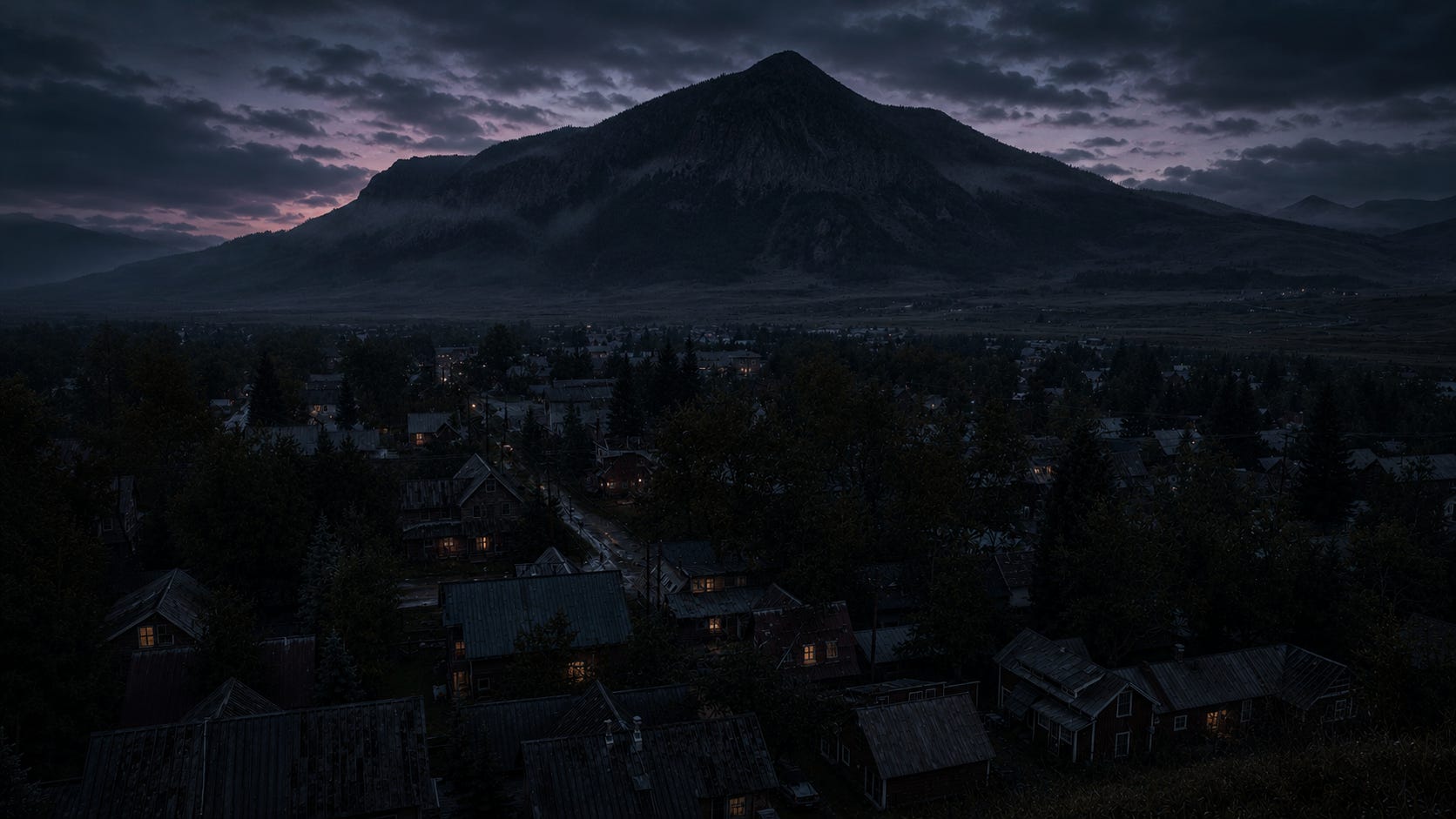
Silas kept his eyes on his work as Chapman came through the door.
He sat behind the counter whittling kindling into careful curls and feeding them one by one into the potbelly stove beside the freight ledger desk. The fire took them greedily. Outside, wind moved grit through the street and against the boardwalk pilings. Somewhere deeper down main street came the slow sound of hammering. Chapman waited for it to stop. It persisted.
“He calls this hospitality...” Chapman muttered to the room.
He moved slowly along the shelves, counting automatically as he went. Four sacks of flour. Eleven tins without labels. Three empty nail drawers. The habit remained long after his talent for accounting had stopped helping him.
“You’re late,” Silas said. “What you see is what remains.”
A dented tin turned slowly in his hand, its label gone white with age, before he set it back on the shelf.
“The road is longer than it was. The outposts are no longer safe to hold. Freight teams ride through now or circle wide around them.” He paused. “I rode through.”
Silas fed another shaving to the stove.
“Some cat houses along the basin road, I’m told. For travelers needing an excuse to slow down.”
“A man needing reasons will never lack them there,” Chapman agreed.
Silas opened the ledger and turned a page.
“All things are growing worse, can’t go on much longer this way,” Chapman said.
Silas looked past him toward the front windows where pre-dawn gathered as bruised violet bands against dusty glass.
“Some of us already know how long,” he said.
He left the sentence unfinished. The roadman had spent enough years on freight routes to know men rarely named a thing while there remained any chance of preventing it. From somewhere beyond the churchyard came the brief helpless crying of a grown man.
Outside, a loosened tiedown strap lashed the wagon siding sharply in the wind. The freight horse answered with the tired distress of an animal worked too long. Mercer the stableman was busy unloading its crates.
Cold air met him as he stepped outside to help.
Together they unloaded three freight crates, two sacks of meal, lamp oil, wool, nails, and a keg of salt before Chapman stepped back inside and let the cold follow him through the door. Across the street the painted letters of FEED & TACK still clung to a warped storefront. The hitching rail before it remained full despite the windows being blackened from inside with canvas and wool blankets.
Silas had replaced the ledger with two cups and a bottle holding perhaps three fingers of whiskey.
“You still have whiskey.”
“I have what I haven’t traded away. Sit down.”
The chair creaked beneath him. Years on the freight routes had compressed him into something sharper, denser.
“The coffee’s imaginary. Ersatz,” Silas said. “But the whiskey is real.”
“That seems about right for the times.”
They drank.
“What did you bring me,” Silas said.
“What the road allowed. Four sacks of salt. Lamp oil. Hinges. Nails. Thread. Needles. Two bolts of wool, though one took water crossing Basin County.”
“How much oil.”
“Less than you’d want.”
Silas reopened the ledger.
“And the hinges?”
“Three dozen.”
“Three? Three dozen hinges for a town this size? Chapman, I’d sooner ask a man to choose which fingers he intends to keep.”
“The northern foundries stopped casting during the winter.”
Silas snorted softly and made another notation.
“Robbery.”
“You still buying?”
Silas looked up.
“I’m still talking, aren’t I?”
The corner of Chapman’s mouth moved faintly.
“And the wool?” Silas asked.
“What are you offering.”
Both men observed it with the seriousness churchmen reserve for liturgy and gamblers reserve for cards.
“You insult me in my old age.”
“You’ve been old since I began hauling freight.”
“These goods crossed two counties and a washout to reach you.”
“And arrived half drowned.”
“That wool survived conditions would’ve killed a deacon.”
“It smells like one too.”
For a moment both men laughed quietly into their whiskey.
Then the bargaining resumed. The salt occupied them longest. Lamp oil against hinges. Hinges against wool. Salt against everything. The figures still arranged themselves automatically in Chapman’s mind even while he understood they no longer described the world.
By the time they finished Chapman had left more than he’d intended: the salt, most of the oil, the hinges, nearly all the nails, both bolts of wool, the thread and needles. In return he had taken canned goods, some dried meal, ledger credit, and promises from a town.
“How far did you come this run?” Silas asked.
“Far enough the middle part has gone vague. I remember departure and yesterday. Everything between became road.” The hauler turned the whiskey cup slowly in his hands. “Prineville boarded every window from the inside, lamb blood painted on most doors, canvas and blankets in the windows. Even during daylight.”
“There would be.”
“They wanted nails worse than food.”
“I left their preacher lamp oil and salt. He never asked the price.”
The merchant looked at the fire a moment.
“You’ve earned a rest, Chapman,” he said. “The road can wait.”
“I have a circuit,” he said. He turned the cup in his hands. “Give me a moment.”
The stove ticked softly while dawn gathered against the window glass.
He stood slowly, the way a man stands when his body has decided before his mind has finished.
Outside, dawn had arrived without announcing itself.
Six figures stood in the street before he realized none had moved.
A woman in a dark coat stood with one hand raised slightly, as though hailing someone across the road. No one stood across the road. Her arm possessed the permanence of a gesture no one had ever answered.
His gaze shifted elsewhere, not because something drew him, but because he found he simply could not continue looking at her.
Two doors down, a man sat outside the barber shop with a yellowed newspaper spread across his knees. Mud stained the lower pages. The irregular typesetting belonged to a printing age Chapman had not seen since boyhood. The man turned each page slowly despite the wind.
The drifting ridgeline north of town was now farther away than Chapman remembered. Not dramatically. Just wrong by enough that a man noticed and said nothing, the way he says nothing about many things on a long enough circuit.
Beyond the churchyard stood the old oak, and three bodies hung from it at varying heights. One remained mostly intact beneath a good coat. The second had opened below the ribs some time ago. The third existed only from the waist up. He looked at them for a time. The darkness beneath the oak was deep and still.
Then something in those shadows moved.
An onyx ram, broad necked and powerful, its shining coat strangely healthy against the exhausted condition of the town.
It backed away from the nearest hanging figure with practiced ease, then lowered its head and struck again with the dull persistence of a creature proving nothing.
For a time the scene held him there, until he understood no one in the street was going to react.
Mercer the stableman worked at the freight wagon. Against the feed store wall several wagon wheels were already stacked near freight wagons, buckboards, and a carriage with yellow paint still showing on the spokes.
The carriage belonged to Hendricks, out of Monument Basin.
Mercer worked without hurry.
The freight horse stood at the hitch post with its head lowered. When Chapman untied the lead and pulled gently, the animal did not move. Behind him through the window the store was warm and lit and Silas sat in his chair by the fire, unhurried.
Then Chapman clicked his tongue once, low and familiar, and this time the horse’s ear moved toward him and the animal took one step and then another.
The road north was shorter than he remembered it. Not dramatically. Just wrong by enough that a man noticed and said nothing, the way a man says nothing about many things. The sound fell away too quickly behind him. The wind against the storefronts, the strap still lashing the siding, all of it gone before the distance warranted it.
Beyond the edge of town waited a silence that seemed older than the road itself.
The buildings sat pale in the morning light, the oak just visible above the roofline, and then the road curved and they were gone.
Chapman faced forward and kept his eyes where they belonged.
Inside, Silas at his ledger listened to the horse until he couldn’t hear it anymore. Then he brought the volume out and opened it to the day’s page. He entered the morning freight in his careful hand.
Salt. Lamp oil. Hinges. Nails. Wool.
Condition.
Route of origin.
He turned back several pages until he found the names he was looking for.
Hendricks, out of Monument Basin.
Garrow, out of the eastern cooperative.
Defago and his boy, the spring run two years prior.
All entered in the same hand. All crossed with the same single line.
Back on the day’s page, Chapman’s name waited beneath the route marked NORTH.
He lifted his pen. He held it there.
Then he set the pen down without drawing the line.
He sat with his hands on the ledger and looked at the door through which Chapman had gone.
Then he picked up the pen and drew the line and closed the ledger and that was that.
The stove was burning low. He fed it another piece of kindling and watched the fire take it the way it took everything.
Really great read...edgy, and uncomfortable; thanks for this tale...
Stunning work once again!