
Denizen

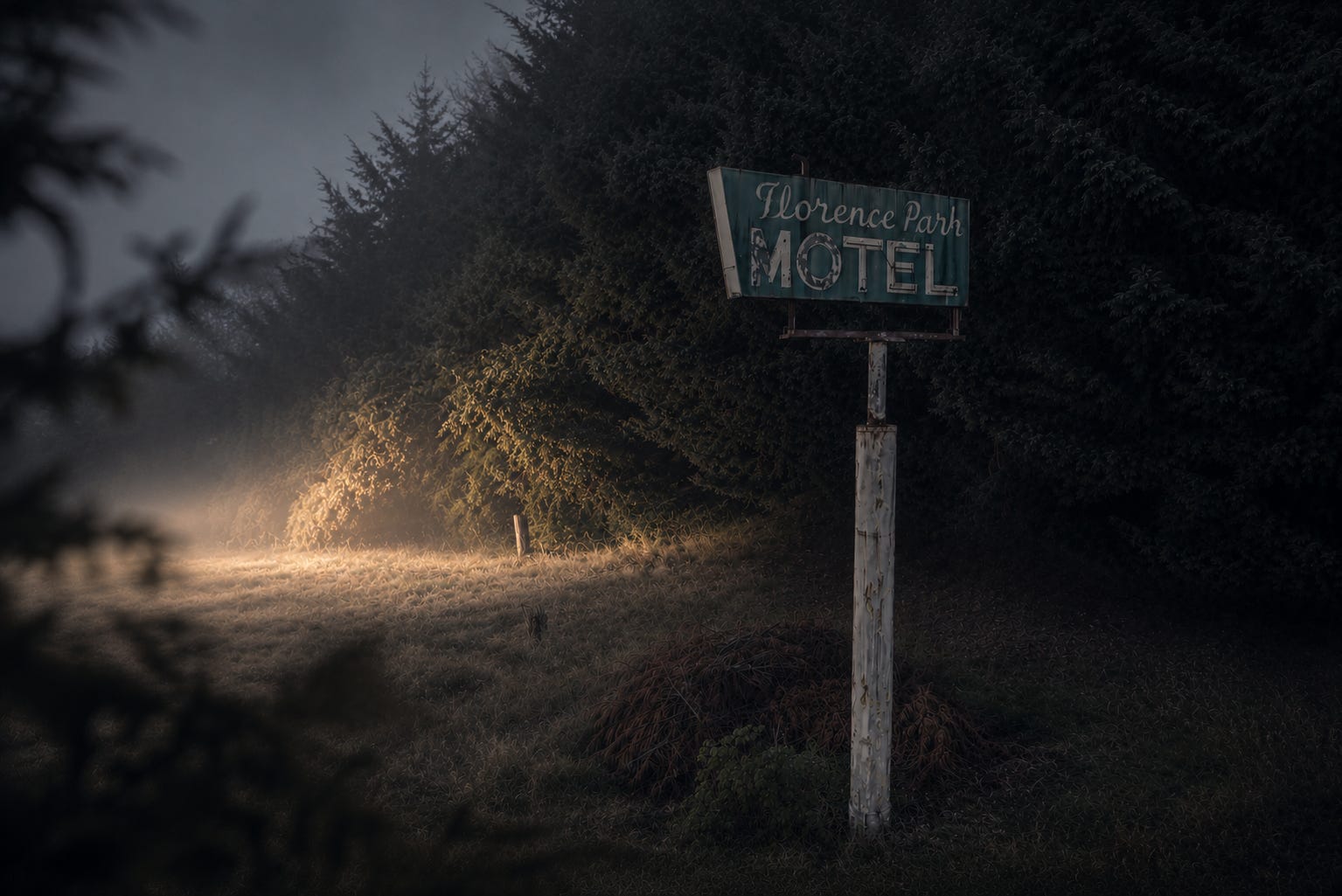
The Florence Park Motel was an anachronism where the old highway gave out into timber. Fire had taken part of it in ’58. Floodwater filled the gravel lot in ’71. Twice, the county had marked it for demolition. In town, people lowered their voices at the property’s name.
After years cataloguing the former logging towns strung along Highway 30, Nora Calloway had learned to do the same. She had never seen anything survive its own death notice as many times as this orphan motel.
Her research began as a footnote in a grant application. The county wanted a heritage survey of the remaining motor courts before the state widened the road and took what was left of them. Nora pulled the property file on Florence Park expecting a deed, a few ownership transfers, the usual. What she found were records that would not resolve: a tax delinquency paid days before seizure, a fire claim paid out with no listed owner, a well permit signed only “groundskeeper.” Small things, on their own. The ordinary gaps a county archive collected like silt.
Still, Nora trusted artifacts. Forgotten things left shadows in them.
The insurance file was the one that snagged. She called the underwriter herself, expecting a runaround, and got one.
“The claimant information was lost during digitization sometime in the nineties,” the clerk explained.
“Could you check anyway?”
After a sigh and a stretch of hold music, the woman returned.
“Nothing.”
Another pause.
“Happens more than you’d think.”
The deed ran through a concern called the Florence Park Trust, formed before the county kept reliable founding documents. Four names had been attached to it across the decades: Pruitt, Marsh, Holloway, Combs. None were related by any genealogy she could find. None appeared in a census within forty miles of the property.
Then she noticed the signatures: four names, one hand. The same backward loop on every y. The same pressure at the beginning of each capital. The same narrow slant. Ninety years.
She found Jodie Anders through the historical society’s oral history list, old enough to remember the highway before it had become mostly hurry and noise, clear-eyed according to the woman at the assisted living facility, and willing to talk to anyone who would listen.
Jodie remembered a storm, her father’s broken axle, and a little red chick named Strawberry.
“Strawberry?” Nora asked.
“My chick.” Jodie smiled. “For three days, she was the whole world.”
“There were hawks out there,” she said, hands folded over her cardigan in a sunroom smelling faintly of disinfectant and coffee. “The man working there had given her to me that afternoon. His gift. That night she got loose in all that wind and rain, and I ran out like a fool child to save a chicken.”
She gave a small, dry sigh.
“The hawk got her before I did. He came after. I don’t know where from. He just... was there. Lifted that poor little thing out of the mud.”
She looked past Nora for a moment.
“Hands like a man who’d never worn gloves in his life. Gentle hands.”
“And his eyes?”
“So blue.”
“Do you remember his name?”
Jodie’s expression changed. Not into confusion, but into the stillness of someone fitting a key into a lock that no longer existed.
“He worked there,” she said at last. “Kept the place. I want to say...”
She stopped. Started again.
“It’s not that I can’t remember.” Her fingers tightened around one another. “It’s that there’s nothing to grab. Nothing where it should be.”
Without meaning to, Nora tried to picture him. She found only rain.
Over the following weeks she found the same absence elsewhere: a boy pulled from an irrigation ditch, a fence mended overnight after a storm that should have taken the building down, directions given by a man no one could describe. People remembered what happened. Never the caretaker.
The motel sat beyond the last gas station that still pretended to be open, where the old highway gave way to timber. Black walnut trees crowded the edge of the property, poisoning the ground beneath them. The office opened onto a horseshoe drive lined with clapboard units faded to the color of driftwood.
Nora had read the structural assessment declaring the place unsafe without major remediation. It stood anyway. The roofline held true. The porch boards did not give beneath her feet. New glass shone in old frames. Fresh mortar filled old joints. Along the office wall, beneath the walnuts, a row of roses held in impossible soil.
At the edge of the lot stood a fence post with a small notch carved near its base, shaped like a bird in flight. She had seen it that morning in a photograph from the county archive. The post had been pale and new. The notch had not changed.
A man worked behind the office where old machinery sat beneath open sheds. He split wood while hens scratched around his boots. One of them was deep rust red.
For a moment Nora thought of Strawberry.
He looked up before she spoke.
“You’d be Nora.”
Not a question.
“Calloway, now. Your grandmother was a Pruitt.”
The name caught her. She had spent days reading it in trust documents without once thinking of her own family.
He nodded toward the roses.
“She planted those.”
Nora owned three shoeboxes of family photographs. Church picnics. Birthdays. A beach trip in ’66. Nothing from here. No picture of a young woman kneeling beneath walnut trees, pressing roses into reluctant ground.
There should have been a story. There wasn’t.
The man leaned the axe against the chopping block.
“Do you work here?” she asked.
“I look after it.”
“Who are you?”
He glanced toward the office.
“Won’t be remembered.”
“What’s your name?”
“That won’t either.”
He nodded toward the open door.
“Ledger’s under the counter.”
“You’re just going to let me read it?”
“Looking’s never been the trouble.”
He picked up the axe again.
“Go on.”
The first strike landed before she reached the office.
Inside, the room smelled of dust, old varnish, mice, and paper that had outlived the people who wrote on it. Brass key hooks hung behind the counter, green with age. A coffee tin held bent nails. A calendar curled at the corners. The ledger waited beneath the counter.
Outside, the axe fell again.
She opened it. Guest names filled most of the pages in a dozen different hands. The margins belonged to someone else: roof patched; well cleared; fence mended; glass replaced; measurements for boards; hinges needed; back steps softening; roses cut after frost; hen feed low.
The axe struck.
She turned the page. More repairs. Gutters cleared before the winter storm. Glass replaced before the vandalism report. Roses tied before the wind. The dates sat wrong against the records she had already read, and the wrongness of them drew the room closer around her.
The work did not follow ruin. It waited ahead of it.
Another strike.
Dust. Dry paper. Old varnish. The sound of the axe settled into the room like another piece of furniture.
She took out her notebook.
Blue eyes. Rough hands. Pruitt. Roses.
The axe struck.
She stopped writing.
Blue eyes.
Had she seen them, or had Jodie?
She looked back at the page.
Rough hands.
That could have been Jodie too.
The axe fell again.
She looked toward the door.
Who was chopping wood?
She had spoken to him only moments ago.
Hadn’t she?
She waited for the answer. Nothing came.
She looked down again.
Pruitt. Roses. Blue eyes.
Someone had told her that.
The axe struck.
Or she had read it.
Another strike.
Perhaps it had always been in the ledger.
She closed the notebook.
Outside, the axe continued. Steady. Measured. Wood split from wood. She listened until the sound no longer seemed to come from outside the office. It belonged to the building itself, as though the motel had always breathed in that slow wooden rhythm.
She looked again at the ledger. Roof patched. Fence mended. Well cleared. Glass replaced. The entries stretched backward through the decades without interruption.
There should have been a name.
There wasn’t.
The axe fell.
She searched the page again. Guest after guest. Season after season. Storm after storm. Always the work. Never the worker.
For a moment she stood perfectly still, certain there was something she ought to understand. It hovered just beyond reach.
The axe struck again.
The thought dissolved.
Nora closed the ledger carefully and slid it back beneath the counter. The room smelled of dust and old paper. Nothing more.
She went outside.
The afternoon had drifted toward evening. Shadows from the walnut trees reached across the gravel. Behind the office, the chopping block stood beside its pile of split wood. Fresh chips lay in the dirt. Hens scratched around the sheds. One of them, deep rust red, worried something from the ground near the roses.
No man stood there.
Nora waited.
The yard gave her only hens, old machinery, the dark office window, the roses holding in poor soil. She looked toward the trees, then toward the sheds. There was no axe in motion. No worker. No one resting from labor.
Had she heard chopping?
The question seemed foolish once she had asked it. Old buildings made old sounds. Boards settled. Branches knocked.
She walked to her car with the notebook tucked beneath one arm. Halfway there she looked back at the roses.
Someone kept them.
The certainty remained. She could not have said who.
She drove home with the windows down, sorting the afternoon into ordinary tasks. Pull the Pruitt records again. Check the trust names against death certificates. Ask the historical society about the roses. Find who had been maintaining the place.
Somewhere in the work, she thought, there had to be a worker.
The report she filed with the county described the Florence Park Motor Court as structurally and historically significant.
Current caretaker: unlisted.
It remains standing.
Behind the office, the axe resumed.
So artfully subtle.
Blue eyes, no name. Who’s chopping the wood Gan? Love my weekly dark room visits x