
Below

I.
A shot taken was a contract.
The long day’s walk had left him empty-handed. His wife and the new baby waited at home. He saw the pale patch under the buck’s throat and fired.
As his rifle reported, he already knew he had missed his mark.
The bullet entered the buck’s gut. The animal vanished unsteady into vine maple and salmonberry. He pursued.
“That’s Rocky Point,” Pruitt said, coming up behind him, out of breath. It was a warning.
“I can see that.”
“You know what I think of it.”
“You’ve told me what you think of it every time we’ve come within a mile of the place.”
Pruitt had a habit of stopping to listen: birds gone quiet, a change in the wind, nothing at all the hunter could name. Pruitt was not given to nerves. That was what made the habit irritating. He stood at the tree line now with his rifle held loose and his head tilted, listening.
“Leave him,” Pruitt said. “He’ll go down on his own inside the hour. We come back for him at first light.”
“He won’t hold together that long. Coyotes will have him gutted by morning.”
“Better the coyotes have him than the two of us break a leg chasing blood in the dark in that country.”
The hunter didn’t answer. He was already moving. The wound was his, too.
“I’ll go as far as the marker rocks,” Pruitt called after him. “Not past. You hear me? Not past the rocks.”
The hunter lifted a hand without turning. It may have meant he heard. It may have meant nothing.
Pruitt let him go.
The going was slow. Rugged hills and valleys rose against him. His knees had complained since the last climb, but he blamed the country. He did not look back to see whether Pruitt had kept his word about the rocks, assuming he had.
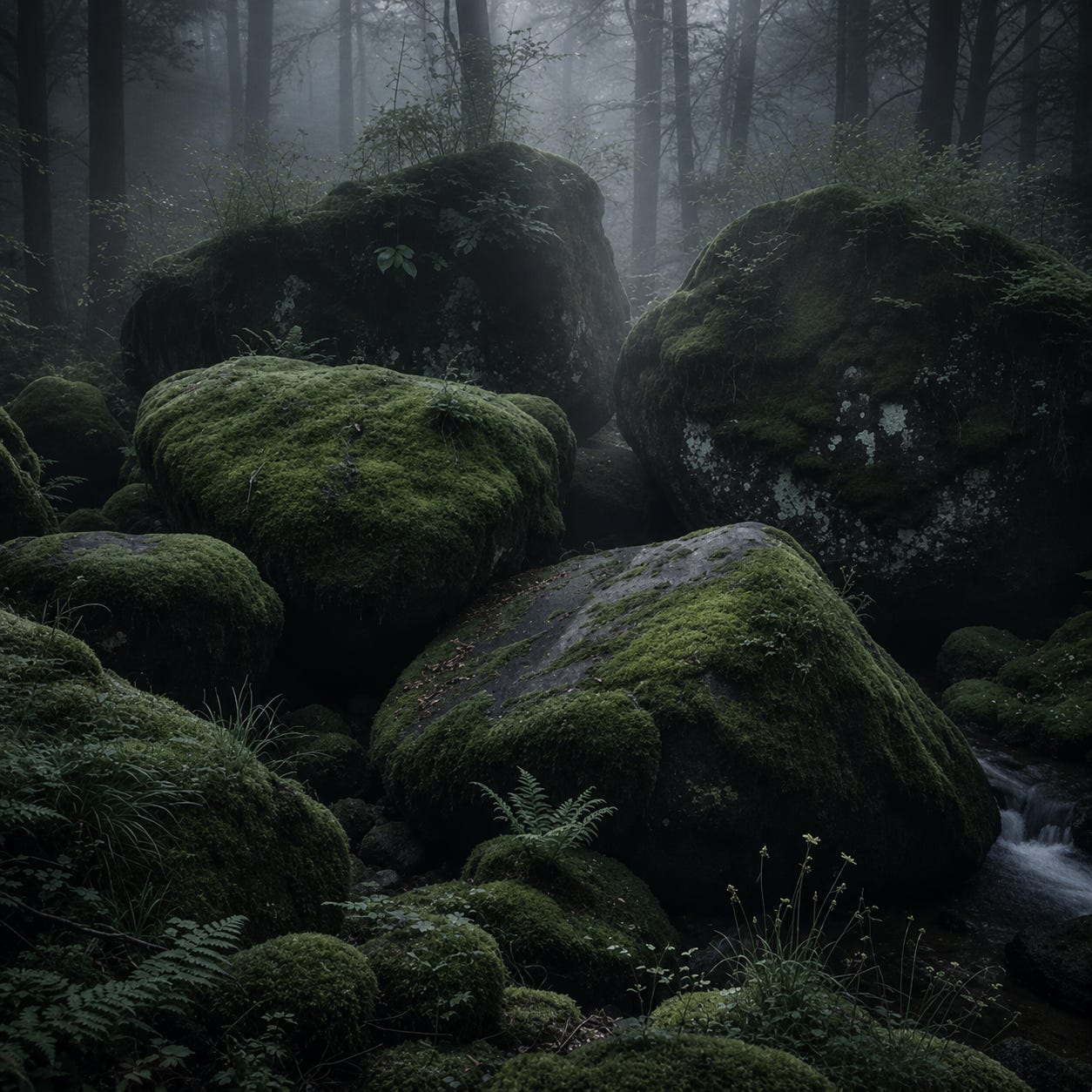
Here the land was sharp stone dressed in lichen and clutched by the knuckled roots that fastened the canopy overhead to the earth. Ferns grew thick over places where the ground looked solid and was not. Blood darkened the green ahead.
The canopy concealed most of the light. Little sun reached what grew below. Vine and moss covered much of the ground. Bleeding heart and salmonberry showed here and there in pale, misplaced color.
The hills rose and fell ahead. At the current peak he paused and stared forward with his breath held.
The land here was made of rain and shadow, stone and root and flowing water repeating themselves without a horizon to break the pattern. His knees burned with every step now, and his breath had gone short, but he did not stop. Somewhere below him, water fell with no direction to it.
He could smell the animal now. Blood and torn foliage marked the path. Death fled ahead of him. Around the rocky feature on the left, blood showed on ferns and wet stone. To the right, the hillside fell away too steep and deep to bother climbing.
The other side of the rise was hidden. He made ready to aim and started up.
By then the world had gone overcast. Rain began.
Nearly gaining the hill, he saw a man standing at the rise.
The man wore a clean dark suit, wrong for the woods and weather. His shoes were polished black and dry. His hands hung empty at his sides.
The hunter stopped with one boot on wet stone.
The man looked at him with his wife’s eyes.
The eyes were hers exactly, set in the face of a grown man he did not know.
“Pa,” the man said.
The word reached him softly, without echo.
Somewhere behind him, far off now, Pruitt called his name once. The sound came thin through the rain.
Then his boot slipped.
Wet rock failed to hold his weight, and the ground disclosed the chasm whose lip he had been walking without knowing it.
He was battered and swallowed into the earth.
II.
A hole keeps what falls into it.
He was floating.
At first all was drifting. Then discomfort settled over him. Thoughts arrived without context. He was warm and numb, held in the last softness before pain.
He had been elsewhere.
Soon he would drift back into the broken flesh of his body and learn what had happened to him. He had not yet gained access to his own name.
Lying in a thoughtless heap, he strained to get to his feet, but his body would not answer. Darkness all around, but moonlight poured down from an aperture above and told him he was at the bottom of a pit.
Through the torn opening, the five-point buck looked down at him. Its white throat flashed once, then disappeared. There was no triumph in the way it watched him, only knowledge of having escaped.
His body began to shake. His legs lay out before him in the water, his back against an earthen wall. His hands moved over the numb places.
The water came to his waist. One knee rose above the surface. Under his own hand, the leg felt cold and greasy. His pants were torn in new places, with sharpness inside them. More sharp debris lay all around him, though his hands made little sense of it. He was now sure his fingers were broken.
He built the shape of the place by touch. He was seated on a shelf of debris that rose just high enough out of the water to keep him from drowning: bones, branches, old leaves, cloth, rotten matter washed in over years and never washed out. Below the shelf, black water. Below the water, more of the same. Behind him, an earthen wall he could brace against. To his right, past the edge of the shelf, the sound and moving air told him the chasm opened wider and deeper. He would not look there.
Then came the impossible.
A door opened on oiled hinges.
Then footsteps crossed hard flooring.
There could be no source.
He closed his eyes and pressed his hands into the debris until the door shut.
With effort he kept his breathing slow and shallow so his bruised ribs would not flare. His hand found a time-polished jawbone he believed belonged to a cougar. Feeling about again, he found rib bones whose owner he could not place.
Next came the squeak of a serving tray.
Bland food, covered in plastic, was unaccountably pushed under his nose, and the smell turned his stomach. He stared into the blackness and thought he saw unfriendly eyes. The tray was withdrawn.
Pulling himself upward with sudden and real effort, he at last understood the hopelessness of standing. His left leg would not hold him. Something hard and pale pressed through the flesh above the knee. He could not be sure whether the unfeeling bone under his hand was his own or something that had entered him when the fall dashed him into the pit.
The backpack was still on him. Inside it, his hands searched for light.
He found a magnesium block and a small bottle of fuel.
Choosing a place on the wall to his right where the fuel would collect, he filled a suitable depression, applied a little of it, and struck the block. Sparks leapt and died. He tried again. Then again. At last the fuel caught, and his surroundings were illuminated by a pitiful flame.
Beside him, above the waterline, he saw a heap of clothing. A winter coat and torn sleeves. Insulation showing through. The coat had been worn to death.
The little flame on the wall guttered and lowered. The little light made the pit worse by giving parts of it edges. Bone and thick roots. Debris and flowing water. The darkness held the rest.
He must have slept.
When he woke, the flame was gone. No moon showed through the opening. The water had come higher, or else his body had sunk lower into it. His teeth knocked together. His hands had stiffened into hooks.
He waited in the dark for a long time.
Nothing changed.
He could rot with the dead or set fire to what the pit had kept.
He hoped the fire would signal others.
Or end his misery.
He set the clothes alight.
The coat caught faster than he expected, the old insulation going up in a bright, ugly rush, and for a moment he was warm and almost grateful. Then the smoke found the walls of the shaft and had nowhere to go. It rolled back down on him instead of rising, thick and chemical, and he understood too late that he had built a fire in the bottom of a chimney with the flue shut.
He coughed until his ribs screamed. The smoke sank instead of rising, sealing the space above the water, and when he beat at the coat with hands that would not answer him, the fire only spread. His throat closed. He understood then that the leg would not kill him, nor the cold. He had made a smaller hole inside the first one and filled it with smoke.
Then he broke and screamed for Pruitt.
The smoke above him thinned and pulled upward through the opening. Grey sky showed through the gap, and a face leaned into it.
For one instant he thought the buck had come back.
Then the face said his name.
“I told you not past the rocks,” Pruitt said.
His voice reached the hunter before the rope did.
III.
He was caught.
Confusion came first, then the small bright room confining him.
Time in the room did not move the way time moved elsewhere. It pooled, the way water pools and does not drain.
A sink stood against one wall, and a monitor hung above it. The light was white and flat. It did not change with the hours, so there were no hours, only the light. The room smelled of plastic, old skin, and himself.
His wrist was fastened to the rail with something soft that would not give. He pulled, and the rail answered.
He did not know what he was waiting for. Walking had been the work. Now waiting was the work.
Voices passed in the hallway, the way voices had passed through the dark below him once, or perhaps had not happened yet. Both felt present. Neither felt finished.
A woman in soft shoes came and went. She may have spoken to him. He did not keep it.
He watched the door. It showed only a crack of hallway light. The seam held steady and told him little. He watched it the way he had watched the opening far above the pit, waiting for a shape to cross it, though none came.
Then, for one clear instant, something in him settled and he knew: he was an old man in a small bright room, and the woods were decades behind him.
His trousers were gathered above one knee, showing an old man’s leg. It was pale and without strength, with blue veins showing through skin thin as membrane. Two scars stood in the flesh above the knee.
The pit. The stone. Something gone into him or torn out. He could not remember which.
He had to get up before the smoke settled. He had to get above the water. He had to get above ground if he meant to keep the leg.
He held still and listened to strangers, footsteps, caster wheels, small clicks of metal, and the disquieting sounds of machines.
No Pruitt above him. No rope coming down.
No moonlight showed the way forward now. Only the overhead light, flickering softly, eating away at the room.
After a while, someone laughed far away. The sound passed without entering the room.
He wanted to ask the right question, but no question came.
At the edge of his sight, low across the door, the pale throat flashed once and was gone.
He pulled again at the rail. The soft binding held, and the paper tore under him.
Water still moved somewhere.
He was still below.
That was a cool read
The door on oiled hinges and the food tray sliding in are so... obviously wrong for a pit in the woods, and I read past them assuming I'd been given a ghost, and then the third part arrives and quietly informs me those were the only honest details in the whole thing... He's been in the hospital the. Entire. Time..! The pit already happened. Decades ago. Excuse me while I go outside.