
Abattoir

Concerning Challenges and Irregularities at Wesco Leather Works
Submitted by Edgar Ward
Commissioning Engineer and Head Millwright, Western Division
Directors,
My responsibilities include bringing newly acquired provincial enterprises to a modern and profitable standard, overcoming those who oppose necessary change, and directing local men toward levels they could not reach without outside authority.
In the ordinary course of my duties to our organization, I was sent to Wesco, as I had previously been sent to the mill and the quarry. At those concerns I supplied the education. At Wesco, I received one not easily believed.
I have since become party to an opportunity of considerable value, provided the Board acts promptly and with discretion. You have trusted my judgment before this; I ask you to extend it a little further, and I will not waste the extension with caution I do not feel.
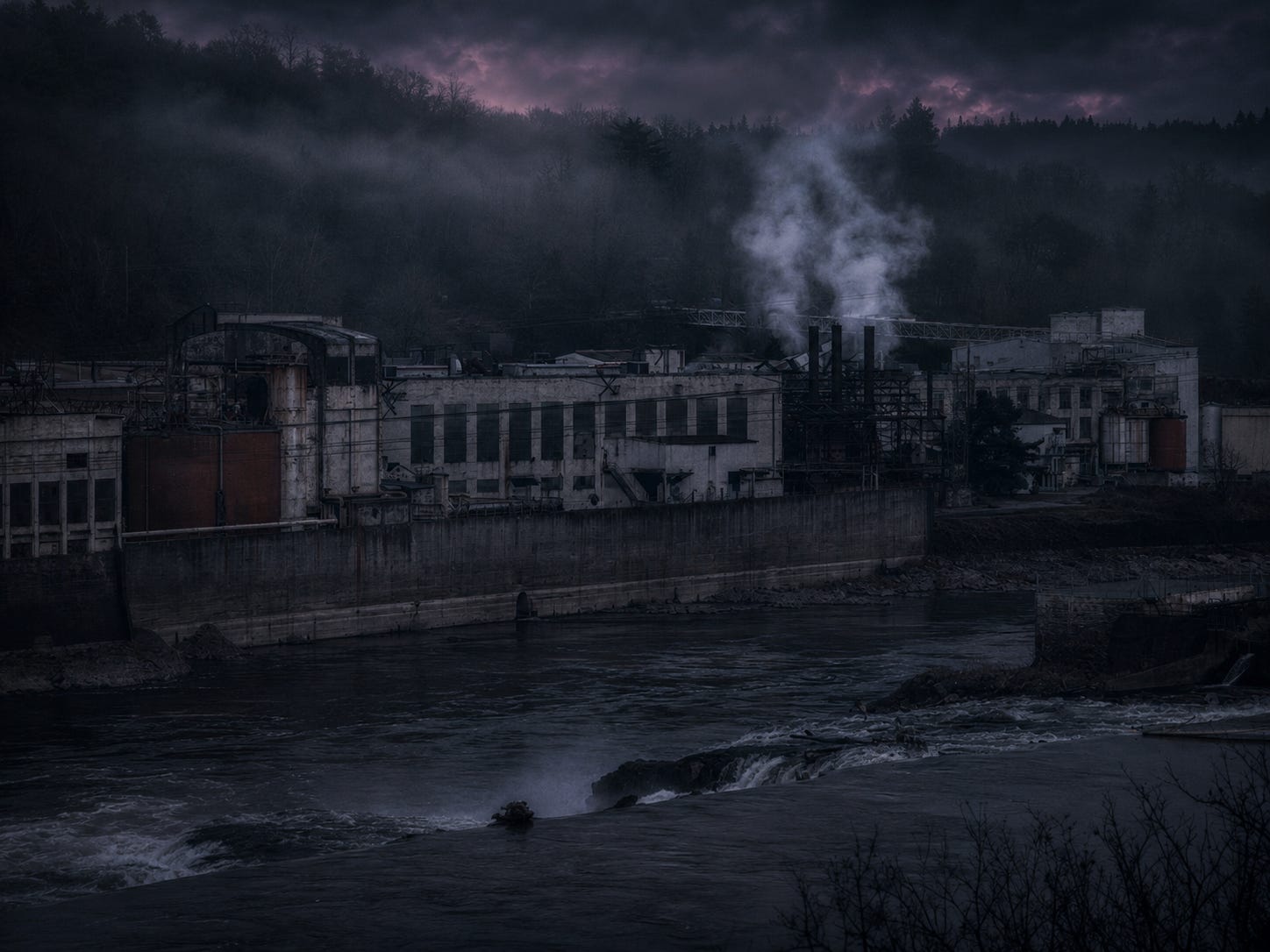
Wesco Leather Works is older than its books and larger than its plans.
It prepares leather hides for distribution and manufactures goods as its contracts require, though the surviving machinery shows that its former business was broader and less clearly defined. Saddlery, military boots, harness and articles for expeditions are represented in old pamphlets and order books. The older hands speak of contracts supplying soldiers, pioneers and colonial parties whose destinations they no longer remember.
Wesco’s present directors may regard these remains as obsolete equipment. They are not.
Upon my arrival, it was the men among the cattle in the yards beyond Receiving who first held my attention. Rain-soaked workers strained to compel the reluctant animals through an opened doorway into the abattoir.
The cattle call in fear and boredom at all hours, their disquiet passing readily through the floors and walls. When the inner gates open and the red work begins, the sound grows. Beasts enter the abattoir at one end and leave, in parts, at the other; I will not describe the process further, and it is no secret to any man at Wesco who cares to look, myself included. I mention the sound because it accompanied much of what follows.
The basement diagrammed in the records and surveys is not the basement I found in the bowels of that factory. The stairs descend to storage rooms and the steam plant, but an old passage continues beyond them, with workshops like graveyards, pits and railed drives shown on no plan supplied to me. Some remain in use. Others are entered only by the old hands, and several are avoided altogether. At their furthest depth I found Harold.
No one gave me a satisfactory account of his position. The manager called him a foreman, the cutters a craftsman, and those who had worked at Wesco longest called him only Harold. His name appears irregularly in the wage books and is absent from several years when he was plainly present. No man could say what authority he possessed, though all deferred to him below. When I asked whether he had been assigned to the basement, the manager replied that Harold had always been there.
Harold is old, without formal education and careless of professional language. He does not distinguish properly between one machine and another. A bench, a steam line, a worker, a length of hide and a drawing frame appear to him as portions of the same shop, each answerable to the others. He has no interest in ownership and little in invention. When an alteration succeeds, he says only that the shop is running better.
The floor men whisper of the Beast. I supposed this their name for one large apparatus. The name may refer to Harold’s principal machine, the lower shop, or an arrangement among several smaller mechanisms which begin and stop together. Harold uses no such name. When obliged to distinguish the place where the old lasting apparatus meets the drawing works, he calls it the coupling.
— On the resistance encountered.
My Commission required the retuning of Wesco. I corrected the power distribution, restored the intervals between the wet rooms and production floors, and removed hazards, waste and compensations which had outlived the failures they were meant to answer. Production improved. The Board will have received those figures.
I draw your attention to Harold’s unauthorized apparatus.
Its oldest portion was a lasting machine from a military boot contract. The original bed and pincer jaws remained, though enlarged and serrated. Harold had joined to them the drawing arm of a dead stitcher, tentering frames of several ages, heated and cooled plates, rollers, drums, presses, hooks, counterweights and steam lines taken from elsewhere in the works.
The strength and compactness of the arrangement impressed me. Smaller machines stood around the principal bed and operated with it in ways I could not trace. Some turned only when another stopped. Others altered speed when tension changed several yards away. Belts and wires crossed walls and returned through the floor. Motions ran contrary in some places and complementary in others. Exposed parts moved with sufficient violence to kill a man, and the machinery produced novel industrial sounds, some of them nearly vocal.
The arrangement occupied several rooms. It stretched, softened, cooled, lasted, drew and held leather for processes which would ordinarily require separate equipment. Harold had enlarged it whenever a contract demanded a result the existing machinery could not produce. The alterations had accumulated without plan, yet the amount of product rendered during the short time I first observed it left me unable to dismiss the work as mere improvisation.
I gave the project more of my attention in the days that followed.
The jaws closed on one count, the frames drew on another, and the lesser equipment answered according to habits of its own. A correction to one assembly caused another to strike or hesitate. No calculation brought them to a common rhythm for more than a few minutes.
The principal difficulty lay at the coupling between the old lasting apparatus and the drawing works. Cured hide tore beneath the contrary pull. Warm hide held longer because it yielded unpredictably according to heat, dampness, thickness and conditions which changed from one moment to the next, but it too failed.
I altered the hooks, changed the draw and reduced the load. Harold restored several of my corrections after I left and did not deny it.
On the sixth evening I told him that his equipment could not be brought into line and that I would recommend its removal. He looked toward the coupling and said that it still wanted something which answered correctly. When I asked what he meant, he said it required something that would squeal when the pull went wrong—something that could feel it—so the parts would know.
I told him that machines did not know.
He let the shop settle the question.
— On the material employed.
I returned on a Saturday, when the business ran with only a skeleton crew, intending to complete my recommendation. I made my way directly to the basement to learn what I could of Harold’s latest alterations.
The lights were out, but there was heat in the deeper passages and movement among the smaller drives. Beyond Receiving, the cattle called separately and then with such force that the sound passed through the walls like thunder.
Before entering the main room, I became aware of the muffled struggling of a person.
The familiar machinery had been augmented by soft, yielding flesh alloyed among its components. Human hair moved in the air driven by the belts. A hand hung beside an open housing, recognizably human despite the manner in which it had been fitted.
Mary Flores, the woman employed at the front office, had been secured beside the motor and moving parts at the coupling.
She was liked among the clerks and floor men, though careless in her work. She lost messages, transposed orders and caused several departments to check her figures before acting upon them. Harold had known this, as he knew where less useful tools are kept and which machines remained serviceable beneath the dust.
The fitting was not complete. Her eyes found mine across the housing.
I looked away first.
The method was rough and outside every approved procedure. It was also successful. The lasting jaws and drawing frame, which had fought one another throughout my Commission, were moving in agreement. When strain altered upon one side, the living joint reacted and tightened elsewhere. A fault which had remained confined to one assembly passed through the material and was answered by several others. The smaller machines adjusted before the errors became visible in the product.
My first shame was not the shame proper to discovering a crime. It was the shame of a man who had brought instruments, authority and training to Wesco and found his usefulness dwarfed by an old man who required none of them.
I was alarmed by the absence of procedure and by the many dangers Harold’s creations exposed me to. I understood Miss Flores’s suffering and saw that she understood it. None of this prevented me from continuing my examination.
Harold offered no defense. He regarded Miss Flores as a badly placed worker whose proper use had now been found. Her mistakes had burdened other departments; her present labor brought them into agreement. He appeared to consider this practical and fair.
When I asked what he believed himself to be doing, he glanced toward her and said:
“There. We have finally found something she is good at.”
He returned to the fitting while I recovered my composure.
When Miss Flores weakened, the living lengths stiffened and the motions disagreed again. When Harold renewed her distress, the coupling answered. The correction passed outward from the bed. A roller slowed, a cooling plate opened, and the tentering altered their pull by degrees no governor could have managed.
Pain calibrated the machinery. The perfection of the product was undeniable.
I corrected the angle of the principal hooks; Harold corrected my pressure upon the material. I altered the sequence of the jaws, and he changed the draw to meet it. We worked poorly for a time and then with an ease I had never known beside another man. Harold knew what the living material would bear. I understood what motion the equipment required.
Before the work was complete, I had ceased considering whether it should continue and had begun instead to consider how it might be preserved.
— On subsequent operation.
The lower works entered regular use the following morning. The floor men did not ask what had been done. Some would no longer enter the deepest rooms. Others accepted the improvement as they accepted any change which reduced broken stock and lightened the shift’s labor. They continued to call it the Beast.
Miss Flores remains incorporated at the coupling, alive and aware. When she becomes unresponsive, the machines lose their sympathy and return to their former habits. When pain is renewed, information passes through the living material. One apparatus answers another. The equipment at Wesco no longer merely operates. It communicates.
I use that word with care.
Production now exceeds my estimates and continues to grow. Goods pass through the lower works at higher quality and with less waste. Leather previously rejected accepts forms and finishes not obtained elsewhere at Wesco. Several pieces have shown properties I cannot assign to the hide, the apparatus or the coupling.
I reported the improvement through channels and received the Board’s commendation and an inquiry concerning expansion. I did not disclose the method. Men without standing would have seen only the appearance of the work, called it monstrous, and stopped it before its principles had been established.
By the third week, I had begun to understand that the usefulness of a man may lie elsewhere than in the work for which he was hired.
I selected a new employee from the lower bed and brought him into the basement under the pretext of instruction. With Harold’s assistance, I learned how living material might be grafted into a secondary junction of the machinery. The man did not survive the fitting.
There is no overestimating the value of what I learned.
I omit his name; it carries no weight here. His family received the usual account and a stipend to keep them from asking more. The occurrence was presented as accidental, though I am no longer certain that the motions below can be divided into accident and response.
After his death, the intercourse among the equipment increased. The hesitation in the jaws disappeared. Cooling plates opened in anticipation of the draw rather than in answer to it. A smaller press in the adjoining room, never joined to the coupling, altered its stroke and produced sound work without adjustment.
Harold observed this without surprise and continued his maintenance. My attention went first to the improved communication and afterward to the man who had been lost.
Certain memoranda, established in our tradition, hold that an irregular principle may be preserved where public interference would destroy the greater value. The matter at Wesco outweighs whatever local difficulty this death may produce. Progress should not be surrendered to local judgment.
No report has been made beyond the Board’s channels.
None will be made by me.
— On necessary authority.
Harold is old, though his age cannot be established from the records. He belongs to Wesco more completely than any man I have encountered belongs to an employer. He moves through the basement as though it were an extension of his body, or as though he were one of its less visible organs. He may have five useful years remaining. He may have less. He has kept no notes and will not begin because I ask it.
Of late, he has begun to note how long I remain below before I tire.
If Harold leaves, dies, or loses the portion of himself which answers the shop, the principle may be lost. The apparatus alone will not preserve it. I can describe the coupling and reproduce its motions, but I cannot determine how Harold chooses the living material, where he expects pain to travel, or why one piece of machinery is admitted into sympathy while another is rejected.
I therefore request three things.
First, confidential authority over Harold and all work proceeding from him. He must not be dismissed, publicly honored or informed of the value placed upon his methods. He should remain at Wesco under ordinary terms while his movements, alterations and selections are brought under our control.
Second, personnel and resources to document the lower works without alerting local management to the object of the inquiry. The basement must be surveyed again. Its unrecorded rooms and apparatus may contain work which Harold does not consider separate or worth mentioning.
Third, authority to assume possession of Harold when the Board considers the observations sufficient. This must be done quietly. He should not be approached as an employee receiving promotion or an inventor being rewarded. He should be transferred with his tools and enough ordinary work to prevent him from understanding that he has passed into custody.
Wesco may continue production. The local men believe the improvement mechanical, and the office believes it the result of my Commission. Both beliefs are useful.
For the present, the shop is running smoothly.
I remain, Gentlemen, your obedient servant,
Edgar Ward
Commissioning Engineer and Head Millwright
Western Division
Postscript. Since this report was completed, Harold has added two smaller machines to the lower works by making use of human material previously regarded as useless. Both have begun operating in sympathy. Mary Flores remains alive, aware and responsive. The complaining cattle are passing through Receiving as I write.
The basement is answering them.
The way the truly horrifying elements are presented in such a clinical manner is brilliant. It dawns slowly what is actually going on. Awesome work!
I love the crazy amount of horror silently woven into this story- The matter of fact- ness makes it too real . I’m almost curious but I know better