
Monument

Their founding monument stood where the basin steepened, an epitaph marking the point where escape became difficult. The land gathered itself into a funnel of gullies and hollows, where passage narrowed and lingered. Here was the least perilous road into the high country, though not the only one tried, and travelers were greeted by relic spokes and iron left by pioneers who once carved through virgin wilderness, arranged into a masonry monument later disturbed by scripture, graffiti, and nationalistic fragments set into its mortar.
It stood in disrepair, still bidding welcome, still declaring a population of 340 and shrinking, though no one agreed when it had last been accurate.
The genesis of the community was desperate men. Arriving with doomed families, schooners and Conestoga wagons proved incapable of ascending those frozen evergreen hills. Some said they endured. Others said something in the pass answered their call, arrangements made in the language available to men without recourse. Their survival was rumored to have been secured by murder, robbery, and cannibalism. For a generation, a presence in that pass fed well.
They came to dominate the place that had nearly destroyed them, and in time were celebrated for it. The railway came, the town prospered, and it retained its appetite for confrontation, a people proud and immune to reason, the resistance demanded of them by something they had never named.
Solicitors and canvassers who intended to pass through did not arrive at their destination. Migrant workers came for a season and were not seen again. These things were noted only in passing, then not at all, and the town found quiet satisfaction in the impediment it offered. Those who tried to cross the trail to higher ground were slowed and sometimes stopped.
Local pride thinned and the town became rote, pacified, and bleak. The soil went thin. Gardens failed without explanation. What once took root now resisted; the ground had withdrawn its consent and would no longer participate in their survival, requiring terms they had long forgotten.
Silas the grocer did not share this satisfaction.
In forty years behind his counter, he had extended credit without discussion and remembered every order without being asked. The ledger he kept had long ceased to balance; names remained, sums accumulated, and nothing was ever settled, yet he continued to write, the act itself holding the town in place by will alone. He had never asked how certain items came to be in his inventory, only that they were accounted for. He argued, gently and without success, for repairs to the station, for reopening the road, for reasons to remain that were not merely habit. What he did not say was that the town had already spent itself, and that he had chosen to spend himself in its place. He delayed its ending not from hope but from uncertainty. He took his seat in the back pew near the exit, as he always did, the last man still interested in its continuation.
At last, the future bleak and prospects so few it was agreed their old ways were a liability. The ground had gone out from under them and they had no enemy to fight, no language to explain themselves. They had lived their hostile creeds earnestly, but what had been built atrophied and was consumed by forces older than memory. Most spoke quietly of leaving. Others decided to tell themselves they did not care. Trains passed less often, then not at all. Wind moved freely through the streets. Doors hung open. The town remained arranged as it had been but no longer served any purpose, and almost everyone still there attended the church on the hill.
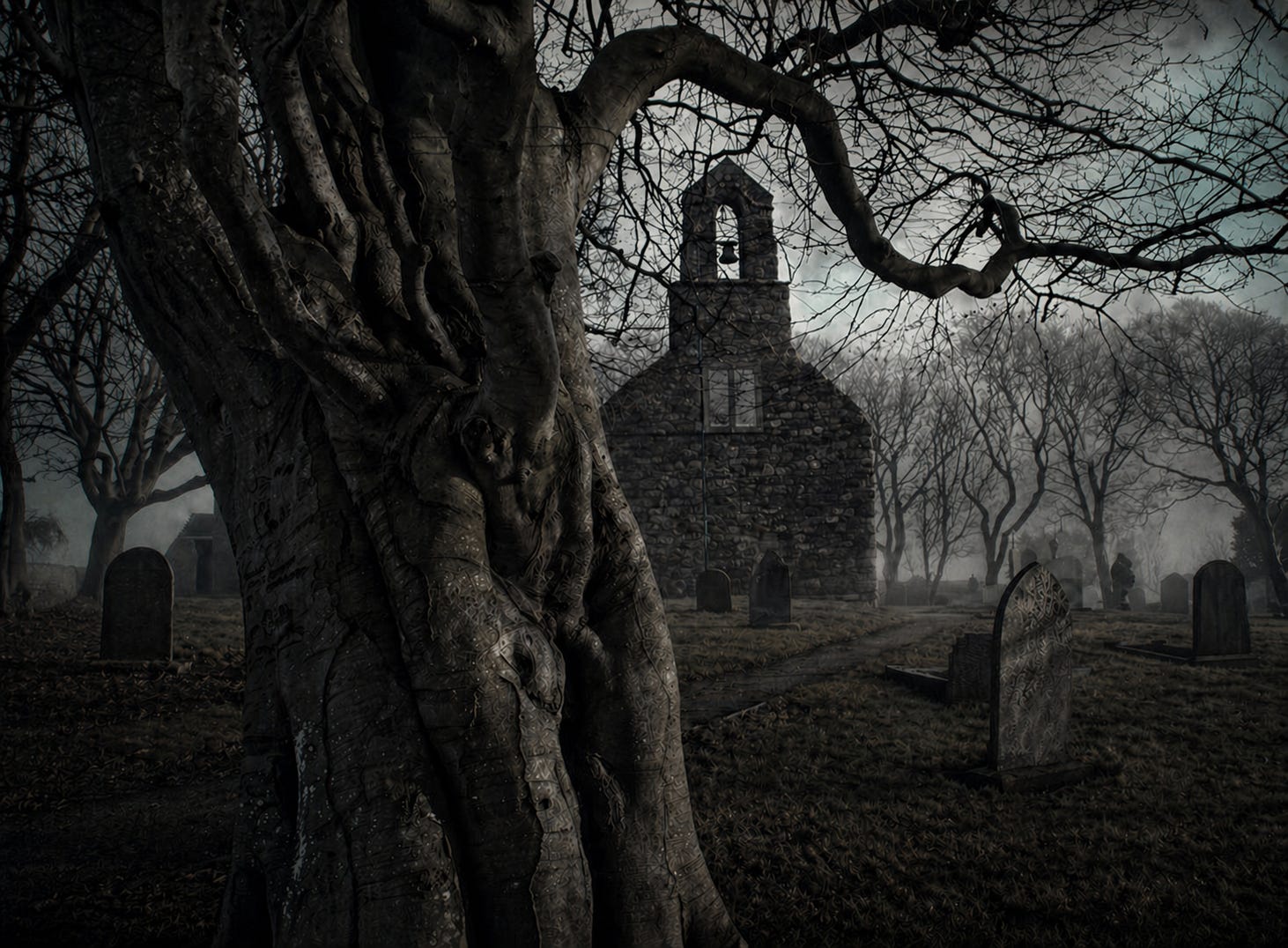
The church of Christ stood beneath an ancient oak overlooking the town center, paint peeled, moss gathered on the shingles and in the gutters. Congregants sat on hard pews beneath branches that pressed and scratched against the glass, the gnarled tree outliving every structure built around it, older than the graves it shaded and the church raised in its shadow. Colloquially known as the hanging tree, it had long served as a place of gathering, burial, and decision, though its use had never been formally agreed upon. There had been a season when the branches bore more weight than leaves, though no record agreed on why.
More people waited outside before service than usual, several new SUVs idling in preferred spaces, parked before anyone else had arrived and visible throughout main street. People pointed but did not approach.
Inside the chapel, the preacher stood at the pulpit and looked over the congregation filing in, knowing each by posture and habit. “We are fortunate this morning,” he began, following the structure that had held for years, speaking of self-reliance, of dignity in refusal, of the virtue of remaining where one had been placed, of strength proven through domination. To this congregation the meek inherited nothing; what was not taken was not deserved. The sound came first, car doors shutting in deliberate sequence, and beyond the glass movement began without urgency, figures passing between vehicles with a precision that suggested repetition, one drawing a length of rope across his hands and testing it.
“We are not forgotten,” the preacher said, the cadence intact even as its conviction thinned. “We are not forsaken; we will now be accounted for.” He did not look at the congregation as he spoke. A deacon moved toward the doors, but they slammed shut with force enough to throw him back. Unease thickened, drawing people to the windows where the men outside stood motionless, their faces failing to resolve, each bearing the same small motions, the same signal reaching each at once. The preacher’s hands loosened on the pulpit. “There are seasons,” he said, “when what has been given must be returned,” the phrase arriving intact, already spoken. Shovels entered the soil. The sound multiplied.
Silas rose, hands on the pew. He waited to be recognized. He was not. “We don’t do things like this here,” he said. “You don’t come in and take a place.” The words found no place to land. He turned and found one of the figures from outside beside him, close, featureless. He was taken.
A tall, gaunt figure no one had seen enter was now approaching the pulpit. He moved through the congregation without resistance, the space parting around him.
The preacher turned, began to speak, and stopped. He did not acknowledge him. The preacher stepped aside and sat, exhausted.
He placed one hand on the wood and raised the other, and the silence that followed arrived whole, occupying the room completely.
“To your people, my name has been Kronos,” he said. “You have been accounted for.”
Outside, the figures stood still, small motions passing through them in unison.
“You were not preserved. You were prepared. Be proud. You are remarkable, as was the hungry generation that came to me in the mountains long ago, and as others were, in towns that no longer appear on any map. Since those arrangements were made I have been with you. You took well to instruction.”
His gaze moved without searching, assigning.
“There will be no leaving this churchyard. Of what comes next there will be no relief. Death will not find where I have placed you. You will not remain as you are. This has been the most inefficient form.”
The words settled without resistance.
“You will all proceed outside. Do not delay. Do not separate.”
The noise returned in fragments, then gathered, but no one spoke as they moved toward the already open door. Outside, the air had changed, a low overcast pressing down while distant buildings smoldered and figures crossed the main thoroughfare without direction.
The congregation gathered beneath the oak where Silas had already been placed high among the branches, suspended at a length determined in advance. His body not permitted to expire, he strained without effect, a low and continuous sound issuing from his purple face, swollen by the rope around his neck.
It occurred to him, too late, that nothing he had kept had ever been meant to be returned.
The graves lay open, their contents removed and arranged with care, not discarded but repositioned, ready for new occupants.
The preacher, vivisected and still living, was fixed against the stained glass, limbs drawn outward until each form occupied its frame completely, the dim light passing through his form, part of the design now.
The rest was guided into place and adjusted, turned, narrowed, brought into alignment with the tree, with the graves, with the structure of the yard, while beyond them others were already being assigned, one drawn upward into the branches, another lowered carefully into an emptied grave, received rather than buried.
The fog reached the edge of the yard and entered without resistance, filling the space until the road, the town, and the pass beyond were no longer visible.
Only the space they would be useful remained.
This one was one of the creepiest- pot poor Silas!!kinda got treated like a chicken seems like very , very interesting
Hello, I’m an editor by profession, so when I read others’ work, I respond as an editor. It tends to be more useful to the writer.
This piece operates on a larger scale, and you sustain it with control. The piece reads less as narrative and more as the construction of a system, where place, history, and belief collapse into one another. The monument is not simply setting but function. It holds memory, distorts it, and ultimately enforces it.
What stands out is the restraint in how the horror is handled. It is never announced. It accumulates through detail, repetition, and the language of record and account. The ledger, the congregation, the phrasing of instruction all follow the same logic. Nothing feels incidental. Everything is being counted.
The introduction of Kronos sharpens the piece without breaking its terms. He arrives not as spectacle but as continuation, which is what gives the ending its force. The town was already aligned to receive him.
There are moments where the density of phrasing begins to flatten the pace, particularly through the middle sections. Some compression there would allow the movement to carry more pressure. Still, the structure holds because the tone remains consistent and controlled.
There is clear intelligence at work here. The piece understands that control is more unsettling than chaos, and it commits to that idea fully.