
Inheritance

Inheritance
After a life of poverty borne without grace, and with the reputation of a man who had served time and learned little from it, a large sum of money passed into Carver’s account.
It arrived as inheritance from a relation he had never met. The clan had long been known as a stain, a line of people remarked upon and worked around, spoken of in lowered tones and then dismissed, and he had grown up hearing as much without ever being given details by his mother.
She was the sharpest of them, a woman of few words, most of them corrections, who, when he was small, would look at him and say:
Look what you’ve done. You should be more careful.
He carried that look with him always, not as remorse but as a habit of stepping past consequence, as he stepped now into wealth and property.
He spoke easily of what a man of industry might make of both, of plans, of resale, of equity, of improvement, as though he had always been entrusted with such things, and not one who had come into them abruptly and without preparation.
On a Monday in December, he arrived at the property.
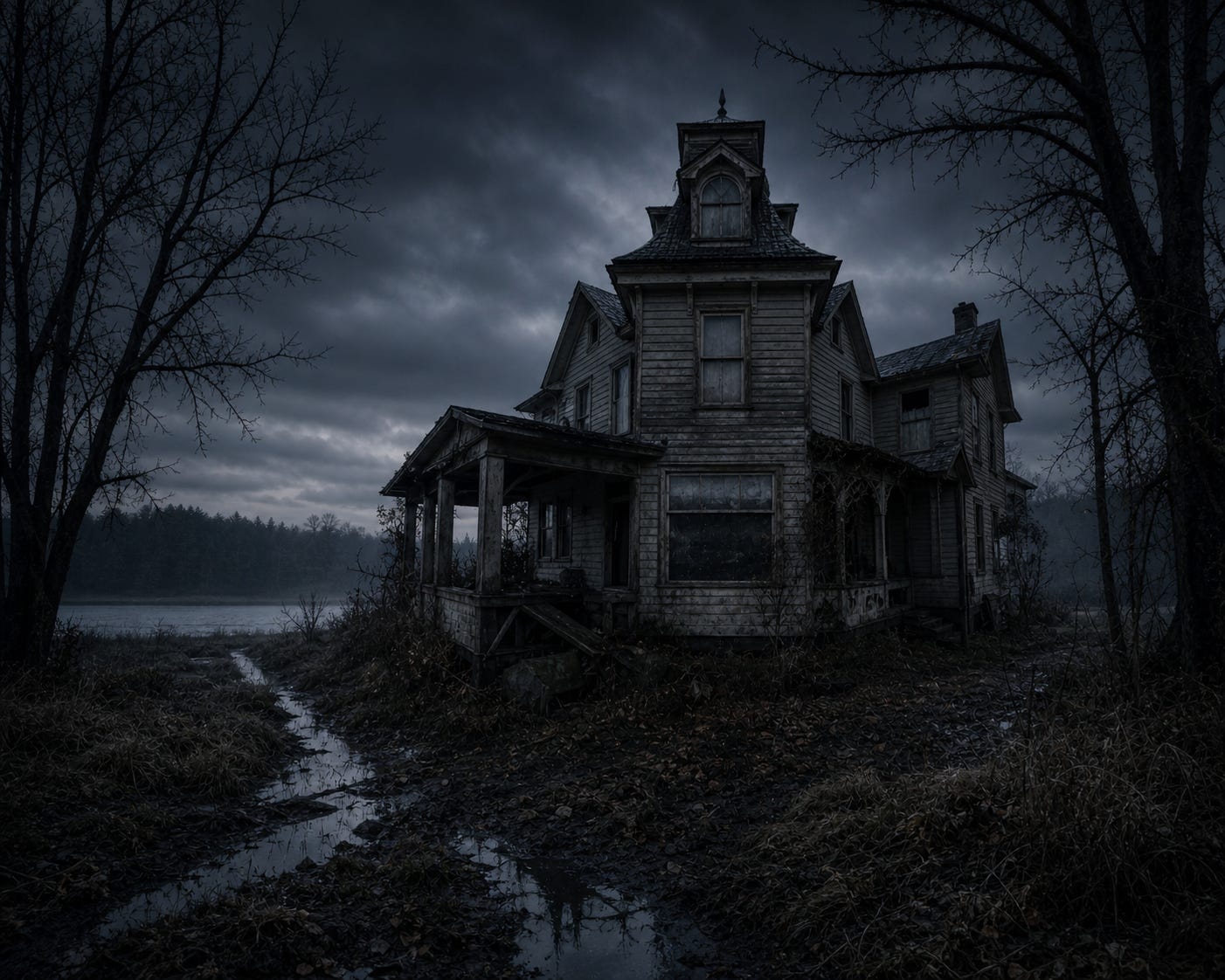
The house stood at the end of a rambling drive, pressed in by neglected trees whose leaves had gone a dull, mottled green and black, their unkempt branches closing in and touching. Across the road a cemetery lay older than the county that contained it, low ground holding frost even in daylight, stone walls and manicured landscaping, well maintained, its stones ornamented but without excess. The place itself was an eyesore, ailing yet enduring.
Once it had been a home arranged for family life conducted with formality, the kind that requires staff, servant bells still fixed to the kitchen wall, a dumbwaiter between floors, the whole apparatus of a house that had once expected to be served; later, orgies and base pleasures had taken place there without shame, decisions and favors exchanged in rooms whose purposes were not discussed. Its rooms were large, the ceilings high, the windows tall and poorly disposed to comfort, their glass faintly warped so that the light entering carried a weak, yellowed cast, already filtered through a long-settled, stifling atmosphere. Carver saw not what it had been, but what it might fetch once stripped, corrected, and returned to use, and he took to the arrangement immediately.
He set about stripping it of what he regarded as excess with a certainty that required no reflection. Records were thrown out. Boxes of papers, letters, and ledgers were burned or carried off without examination. Photo albums were left unopened. Frames were emptied and sold. Faces were removed.
Effort, he believed, would resolve resistance. Boards were pulled, walls stripped, joinery reset where it had settled across decades into positions they preferred.
The house did not always accept correction.
A door he had propped open eased shut while he watched it.
A board he fixed would hold, then rise at one end, recalling its former place. Paper smoothed in the afternoon blistered by morning. A chair moved for convenience returned to where it had stood before he came. His tools appeared in order when he had not ordered them, laid out with a precision that did not match his habits. Doors he left open were closed when he returned. Windows he raised were found shut and latched from within. Once, a door he had wedged ajar stood sealed.
The place was neither angry nor defiant. It simply proceeded. It insisted.
He retained only what had weight, what could be priced, what could be moved, dismissing the rest as residue.
The work soon grew tiresome, and old habits returned.
People were invited into the silence to fill it with noise, to confirm by their presence that the place belonged to him. The parties came in the third month, the rooms filling with laughter, smoke, careless movement, voices without consequence, and he moved easily among them, speaking loudly, drinking freely, a man in control of his circumstances.
On a Thursday in April, the house was full.
The guests lingered into morning, slow to leave, their voices reduced to fragments carried along the drive. Carver stood at the window with a cup in his hand, watching them go, until his attention shifted across the road, where a small funeral had gathered without his noticing it begin, a quiet assembly of dark coats and bowed heads arranged beside an open grave, their stillness in contrast to the careless disorder he had just contained.
Among them stood Felix, set slightly apart, his posture unchanged, his attention not on the mourners but on the disturbance across from him. Carver’s gaze settled on Felix, on the dark coat well cut, the faint gleam of a gold chain across the waistcoat, the weight of a ring catching what little light the morning gave, and he thought:
This is how you get paid.
A coarse hand was raised in greeting. Felix ignored it and continued the burial.
Below the hill the junkyard lay, and among it moved a small pack of terriers, low and tireless, hunting the rats that lived among the heaps and along the foundation. They came up at dusk from unseen places, moving along the walls, pausing, listening, their bodies held in tension that resolved only in motion. Attempts to coax them closer failed; they would not approach him or the house. One stepped forward, then withdrew. Another circled wide, refusing the ground nearest the foundation.
They were dismissed. “They’ve proved themselves useless.”
The pack hunted in repetition. Below them the rats multiplied, filling the hollow frames of machines, nesting in insulation and cloth, moving upward in quiet pressure until they found the hill and the house.
The scratching began. It came from the walls, beneath the floor, within the shaft. It did not alter when attended to.
That night, from the sealed dumbwaiter, laughter was heard, glass touching glass, the party proceeding without him. It was opened. Nothing.
Then, softly, near him, placed at the exact distance his mother had always preferred:
Look what you’ve done. You should be more careful.
No investigation followed.
On a Sunday in August, the second cellar was forced open.
Behind collapsed shelving a low door had been concealed. It gave under pressure. The air beyond was dry at first, then thickened, turning fetid, carrying a sweet rot that clung to the throat. The space extended farther than the house could account for. Barrels and crates gave way to coffins not arranged properly, some stacked, some broken open.
One ancient sarcophagus featured a glass window through which could be seen what had been gathered inside: a collection of parts, an arm browned and drawn tight, a length of spine set wrong, a jaw resting loose among them, assembled without care for origin or completion. Across the stone floor, pale with dust, ran long dragging marks, grooves cut deep where coffins had been pulled from place to place, crossing and overlapping. One set of marks ended cleanly at the wall.
Something had been hidden, forgotten, and miscounted. What could be taken was taken.
The sounds continued.
On the top floor the shaft was opened again, and he leaned into it, and something below spoke, close, as though it had always been waiting.
Look what you’ve done. You should be more careful.
He startled. The boards gave way. He fell.
On a Saturday in December.
A long descent, deeper than the structure could account for, his body catching nails, tearing through unseen construction until the impact came and ended the motion.
Awareness returned slowly. The living room. Silent. Arranged. Seated throughout were men and women of different eras, composed, upright, their hands set properly, their attention fixed upon him. They did not move. They did not speak. They looked at him as though he had made a fool of himself. All of them.
He rose to leave. His body did not answer. Understanding came at once. He was not there. He was laid out below, broken.
The silence held.
Look what you’ve done. You should be more careful.
The room went out.
He lay on the concrete, unable to move, the cold seeping into him, the fetid air thick in his lungs. Something near him shifted and settled into its place.
From the depth of the catacomb came a light. Felix emerged from below. He entered carrying a small, mummified girl under his arm as one might carry a doll. He moved without haste, his dark coat clean against the decay, the gold chain at his waist catching the lantern light. A diamond tiara was removed from her brow, turned once, and set aside with the others. She was placed back into her coffin and arranged without ceremony. The lid was drawn closed with care.
Only then did he look at Carver. There was no surprise. Only a faint smile. A private satisfaction.
He left him there.
Above, the house proceeded.
Interesting use of the passive throughout--obscuring the agent and focusing on the object...the house and its horrors. Tantalizing read.
The mom-voice coming back from the house..? I hate that it’s almost normal, like a tiny scolding in a hallway, and then suddenly... it’s not normal at all.