
Cleaver

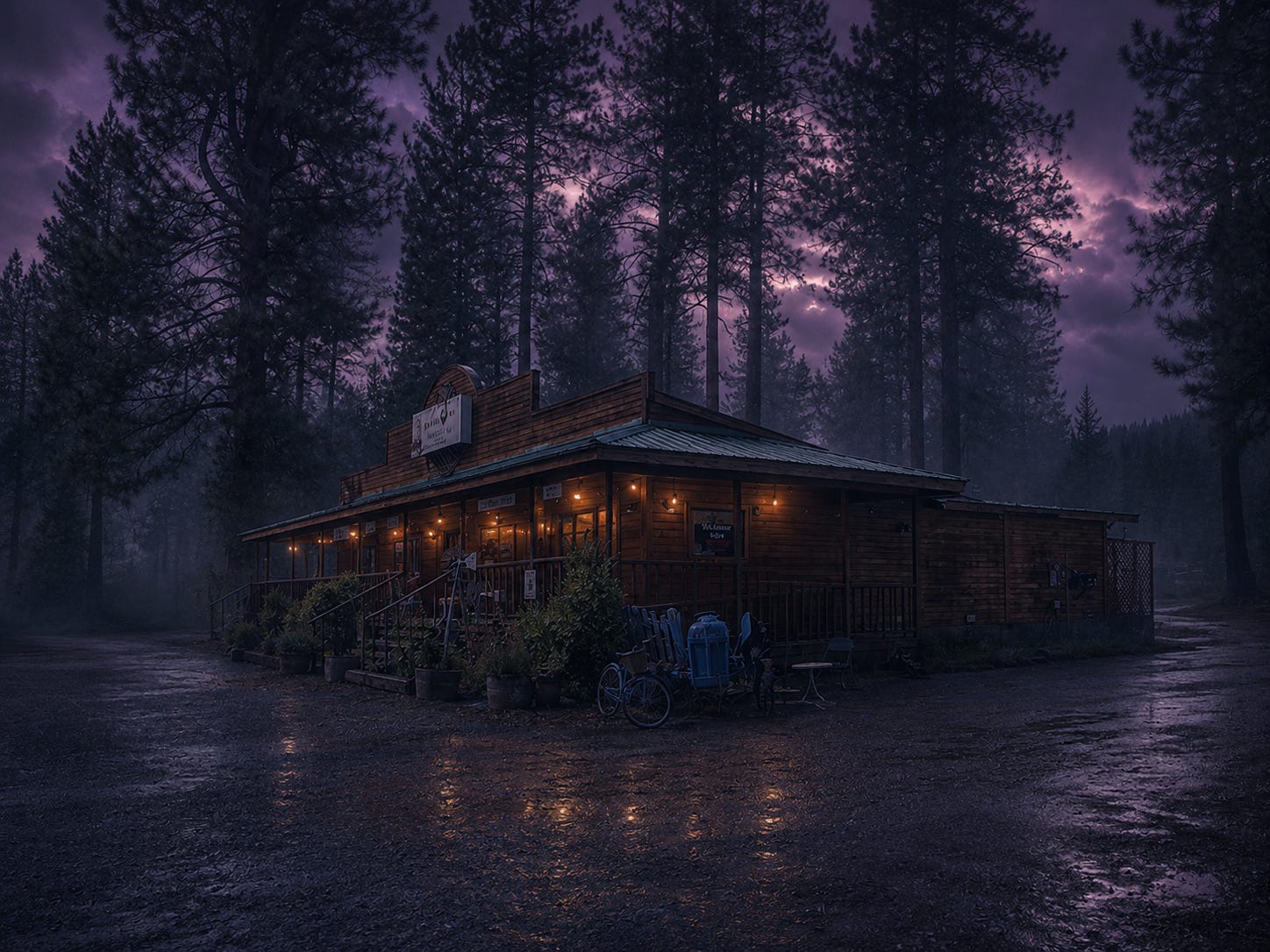
Sultry August nights are for disappearing.
I was wandering with no destination, and it pleased me. The highway climbed Crosscut Hill in long gentle bends, the new road reflectors were like rivets and returned my headlights in a strange green-white glare that annoyed me.
Below, the town gathered all of life’s sundries conveniently into a few crossroads high in the Cascades. Here were buildings and homes with as many windows shuttered as not, the declining remains of a timber economy. Beyond these, rolling hills stretched into country too heavily forested to be properly inhabited. Stumpy clear-cut acres neatly outlined by lush old growth made a checkerboard stretching to the horizon. A number of homes belonging to a lawless population betrayed themselves by lights buried disjointed among the trees.
A lake occupied the lowest part of the basin. From above it appeared squarish and broad, with one narrow channel extending straight from its eastern corner like a handle. We called it Cleaver Lake. My family had rented a cabin there during several childhood summers. I remember Grandpa waking before everyone else to make coffee and split kindling with practiced, unnecessary care. I remember believing the adults knew where we were and why we had come.
I remember believing.
I do not, however, remember where I was before driving up the hill tonight. This did not trouble me. My right arm felt tired, as though I had carried something too long, but after opening and closing my hand awhile I forgot about it. I must have wanted to go somewhere and simply left without telling Marie. Good for me.
Perhaps that was all I needed, to go somewhere without explaining myself.
The Skyline Lounge occupied the same bend in the road where I remembered it, though it had changed names and character several times over the years. It had been a burger joint and gas station famous for milkshakes when I was a boy, later a gathering place for keno and karaoke, and on this night it was something approaching a roadhouse, its windows blacked out and motorcycles parked outside with confident disorder.
The old sign still stood upon steel posts, promising beer with a foam-crowned mug overflowing, gambling with a fan of cards, and EATS with a cleaver rendered with considerably more care than the images beside it. The artist had understood the thickness of the spine and the forward weight of the blade. Even the little round hanging hole had been carefully marked.
I pulled in.
The Skyline looms large in my memory. My father used to bring me there when my parents were fighting. He sat smoking and reading his newspaper while I ate a hamburger, French fries, and a milkshake. During our meal he would explain at length how disappointing life had proven to be. His job was beneath him. The men he worked for were fools. He should have owned something of his own by then. His wife, my mother, was stupid and impossible to reach an understanding with.
He believed in giving advice unprompted, as though wisdom were a debt he owed me. Fair, he told me once, was what a man said to himself while another man took the better cut.
I listened and ate, knowing it was best never to respond while Father raged at the universe at large. At home I sometimes sat in the rain waiting for better conditions while Mother wept and Father slept off whatever had most recently enraged him. Once there was blood upon the bathroom floor. After the worst outrages she would sit at the kitchen table until morning smoking. I could see things for what they were before I understood much else.
My father was trash. My mother was weak. Better not to marry, I decided early, for I did not possess the right temperament.
Somehow, I married anyway.
The Skyline was darker inside than I remembered, the black corners of the room invisible. Amber lighting ran beneath the bar and illuminated bottles and glassware, casting refracted colors about the room. There were perhaps seven customers, all men, none seated together. One had a grey beard and enormous dirty hands resting beside his beer. Another was very thin with a sharp nose and wore a denim jacket despite the heat. Near the door sat a bald man whose neck seemed to disappear directly into his shoulders like a thumb wearing a shirt. They had the compact, unfriendly appearance of locals accustomed to being left alone and were unconcerned that I had joined them.
I took a booth against the wall. The waitress might have been twenty. Her hair was tied carelessly, several loose strands hanging in her face. In profile I noted a black eye healing yellow and purple. She made little effort to conceal it. She placed the menu before me with the weary expression of someone obliged to endure. I ordered a hamburger and beer, and she went away before I had finished speaking.
Her indifference irritated me. As she pushed through the kitchen door I caught sight of blue cabinets within. Then the first blow sounded behind the door.
Chop.
I knew the sound of heavy steel meeting hard wood. There are few tools I admire without reservation, and my grandfather’s cleaver is one.
Grandpa had been a butcher, a man who knew what valuable things were hidden inside a carcass. He worked six days a week in a shop that smelled of sawdust, cold steel, and blood. I remember visiting him there as a boy and watching his hands work with certainty.
The cleaver had belonged, according to him, to his own father, though I never learned whether this was true. Perhaps it was merely something Grandpa preferred believing; he told me many stories that I later understood were intended to comfort.
An old tool exudes its history.
Grandpa’s meat axe makes me feel like a failure when I hold it. Lately I have begun to feel as though it is always in my hand.
He made his living with it. That mattered to me, that I came from people who worked. The cleaver divided, severed, and disjoined to feed other families and earned the money by which his own was fed. There was no romance in this. Then Grandpa was finished with it, and it came to me. Unavoidably, it had become my turn.
The cleaver is broad and flat, part knife and part axe. The edge matters, but so does the weight out in front of your hand.
Raise it properly and gravity participates; it need only fall.
Mine is dark, patinated steel with a broad rectangular blade and a small round hole near the upper corner where I hang it from a hook. The handle is wood, nearly black now, polished by hands that died before my own existed. Three rivets pass through it. One side of the wooden handle shows a burn likely inflicted before my birth. I would never correct the flaw.
My beer arrived, and the waitress set it before me without acknowledging me. Up close, her bruised eye appeared worse than before. Motioning toward the kitchen, I asked if the chef was using a cleaver. Gravely, she said he was.
I mentioned that I owned an old one myself, inherited from my grandfather, who had been a butcher. She rubbed at a place upon the table with her cloth while I explained how the weight did most of the work. The cook, she said, held the same opinion. If the edge was maintained and the blade heavy enough, there was little need to force it.
Chop.
It only had to fall.
I agreed with considerable enthusiasm, though she had already walked away. I wondered why she stayed in this dying town. There were roads out in every direction, cities and respectable employers. She was young and apparently healthy. Nothing visible prevented her from packing a bag.
My mother had possessed the same defect. People have more to do with their own suffering than they admit.
Sometimes I envy dumb objects. They never have to be uncertain. A hammer strikes. A vessel holds—
Chop.
A cleaver divides. We are asked to be what we are not.
I had done better than I expected. I had money, anyway, more than Grandpa and more than my father, who both would have considered me wealthy. I had never forgotten where I came from and disliked people who did.
My grandfather had also given me the ring I gave Marie. It had belonged to my grandmother and had been kept for decades in an envelope before he gave it to me without ceremony. Grandpa said you didn’t throw something away just because something newer came along.
The ring fit my wife’s hand, though she did not wear it daily, which I resented. She kept it safely away except on occasions she considered important. She was good with dates: birthdays, first meetings, marriages, deaths, private anniversaries whose existence I sometimes learned only by failing to remember them. She kept a list in her wallet, updated by hand every year, my own relatives on it as well as hers—people I had stopped thinking of myself. Performative, I always thought it. As though grief and affection required a ledger to be real.
The hamburger arrived and was excellent, the bun toasted in butter and the onions thinly cut. For a moment I was eight years old again, my legs too short for the booth, my father hidden behind a newspaper speaking to himself aloud. Hell could be raised at home and yet a hamburger remained delicious. I could listen to my father rave and still enjoy myself.
He hated his life, and I had begun to understand. The promised future recedes. I had expected to become someone who made good, who lived the life he earned. Instead I worked, came home, paid for things, repaired what broke, worried, and slept in preparation for more work. Nothing tragic about it, just not worth it.
Chop.
There had been a time when my wife regarded my determination as one of my best qualities. Recently it had become a grievance instead. Ungrateful is an ugly word. Sometimes it is accurate and I wouldn’t use it lightly.
Chop.
The impact of the last chop could be felt in the floorboards. Men at the bar glanced toward the kitchen and returned to drinking. Nobody complained.
The waitress passed, and I told her she ought to leave this rotten place while she was young enough to do it. She stopped. For a moment she looked at me as though I were just another man passing through. Then she said she had work to do, took my plate although I had not finished, and carried it away.
Chop.
Perhaps I had been unfair. Never mind. Money gone, never mind. A life spent moving in the wrong direction, never mind. An argument that should have ended ten minutes earlier. A date forgotten. Marie’s disappointed face. Someone asking what all of it had been for.
Chop.
The sound interrupted the thought. My right arm ached again, hot and deep in the muscle. I opened and closed my hand beneath the table and told myself I had gripped the steering wheel too tightly. I drank.
Chop.
This time I felt the sound somewhere behind my eyes. The room seemed quieter than before. The waitress was no longer there, and I became conscious that I had never properly seen the bartender all evening. There had been movement behind the bottles: a white shirt and broad shoulders, a hand reaching to a shelf.
He stepped into the amber light.
My grandfather, who had been dead twelve years.
For an instant I was overjoyed. I stood quickly, striking my knee against the table. Grandpa stood behind the counter. It was the old butcher-shop counter now, scarred wood beneath his hands, the sort I remembered him wrapping meat upon when I was a boy. He appeared much older and frailer than I remembered. His hair had thinned and his shoulders were thin and bony inside his white shirt. I remembered those shoulders carrying sides of meat, his ropey forearms beneath rolled sleeves.
His eyes were as I remembered them, save their mournful expression. I crossed the room to greet him, though afterward I could not recall what words were said. He only looked at me with a sadness so complete that it stopped me while approaching.
The kitchen had become silent. I noticed because I was waiting for the next blow.
It did not come.
I told Grandpa that I still had his cleaver and kept it in good condition. He wasn’t pleased. For some reason I mentioned the ring. His eyes closed, and I understood that he was heartbroken.
He came around the end of the counter and placed one hand upon my shoulder. Grandpa had never frightened me in my life. I was frightened now. He indicated that I should come with him. He was going toward the kitchen.
I did not follow.
The refusal was accompanied by a childish dread. The door had always been there, and I could not understand why I was suddenly afraid of it. Behind that door the cook had been working, the cleaver falling with patient regularity, doing the work put before it.
Grandpa waited. I told him I did not want to go. He nodded, as though this were already known, and at last led me inside while I kept my eyes closed.
One room simply ends and the other begins.
Yellow light illuminates the blue cabinets. The refrigerator stands open. A chair lies on its side beneath the table. Something is broken near the sink, and a dark, tacky wetness has already begun to skin over around the counter.
My right arm is not tired now. It burns, the way a muscle burns while it is still working.
I look down. The cleaver is in my grip: dark old steel, black wooden handle, three rivets, the little round hole near the upper corner, the burn along one side of the handle. I know every mark. My hand knows them too. It feels like I have always held it.
Upon the chopping block rests an arm.
A woman’s arm divided several inches above the wrist with extraordinary cleanliness. Skin, flesh, and the pale architecture of bone are presented in cross section. A familiar hand rests on its side. Upon the ring finger is my grandmother’s ring.
The stone catches the yellow light, casting it around the room.
Blood crosses the kitchen tile in a broad irregular trail, already dark and slowing at its edges, and passes through the doorway into the hall.
Love it from the starting setting.
The mounting horror got me in this one!