
Broadcast

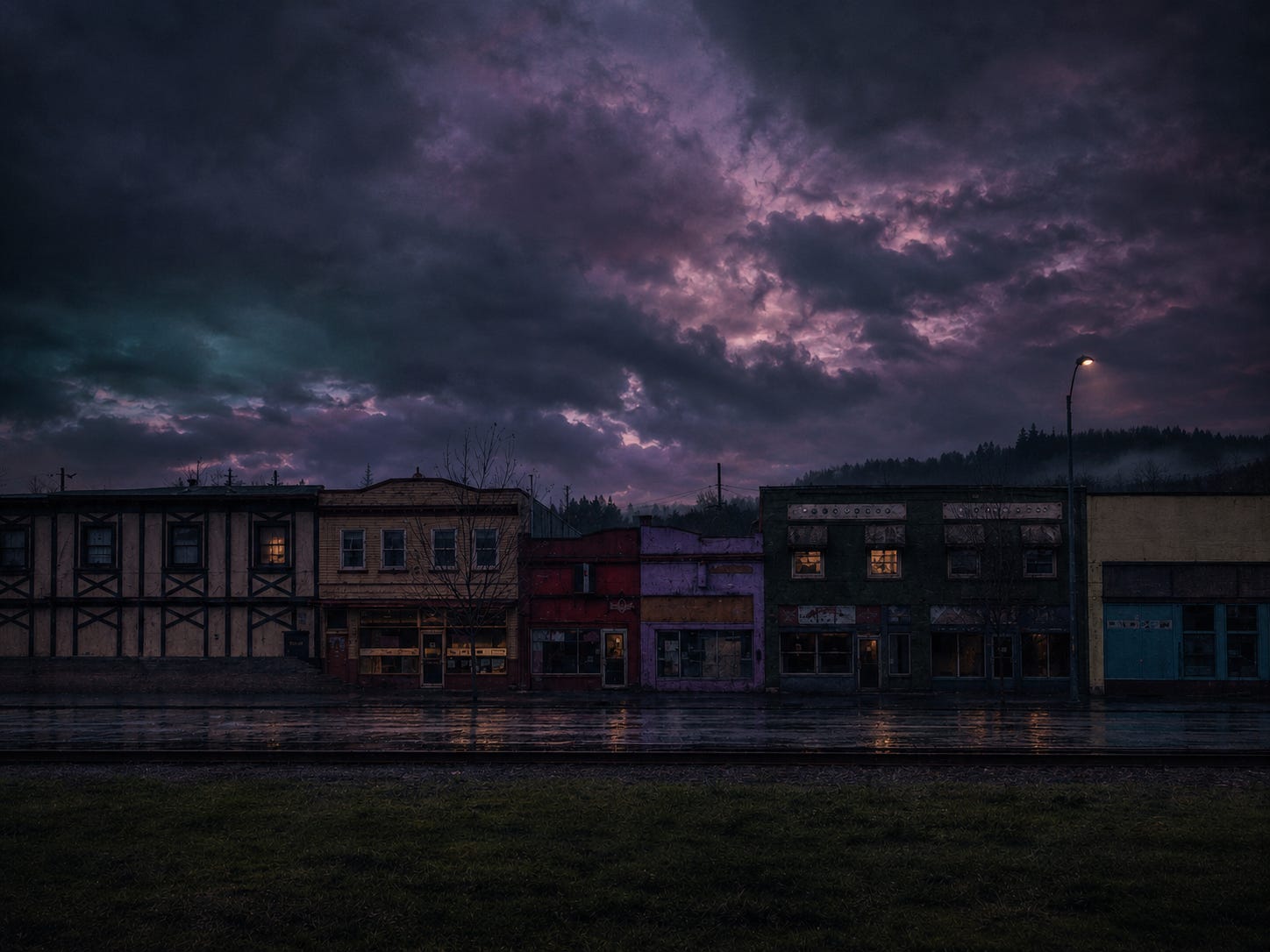
The storm warnings repeated continuously over the AM band, issuing from the local college receivers in tones of rehearsed composure. A broadcast intended to calm the population and discourage inquiry. No one at the mayor’s office would specify what distinguished this weather event from the ordinary spring storms common to our county. Unauthorized gatherings increase noticeably during prolonged weather emergencies. The county has documented this. Even I, as deputy mayor and fourth in leadership, could obtain no further information.
Residents are reminded not to gather unnecessarily during these unique periods of atmospheric instability.
Power failed intermittently throughout town before noon. Internet service followed shortly afterward. Repeated radio notices indicated emergency weather conditions, nothing explained. Reception quality generally improved farther from town.
Near Main Street one felt a species of gravity upon perception. Thought slowed there and the village pressed inward against the mind. Conversations acquired delays. Men answered simple questions late and with visible effort. Traffic lights cycled confused colors. At the courthouse annex a clerk told me, without humor, that the clocks were keeping correct time but taking longer to do it.
The college broadcasts persisted throughout the afternoon. The voice delivering these statements possessed the mechanical composure of being trained exclusively to prevent panic. Beneath the broadcast persisted the noise of a crowd murmuring, a low humming interference not wholly electrical. When the dial was turned between stations one could hear three dull pulses beneath the static.
People spoke softly, counting in rhythm without appearing to notice they had done so. Everyone seemed lost in their own thoughts that afternoon.
What had been intended as a pleasant spring market day became infamous throughout the county. Market days ordinarily required a degree of tolerated disorder the county permitted for economic reasons. Presently residents stood outside the diner and storefronts watching distant skies and discussing cloud formations with the solemnity usually reserved for funerals and failed harvests.
At the mayor’s office the barometer dropped steadily all morning, enough that several among county leadership exchanged knowing looks whose meaning they lacked the courage to state aloud. By noon the pressure had fallen low enough to ache behind the eyes and cause nosebleeds. Rain began shortly after three o’clock and continued without interruption into evening.
I first observed the presence of the figure crossing the park before the library while assisting market staff in dismantling the remaining produce stalls ahead of the storm. I became aware of her gradually, in the manner one notices a sound already present in the room.
She wore browns and carried a scaly leather-clad violin case darkened from age. The brim of her hat shadowed the upper portion of her face. No one else appeared to notice her emergence from the roses along the park path until she had already crossed half the square. Her outline flickered like a corrupted signal the town itself struggled to carry.
I marked her immediately as the sort of person our ordinances were never designed to contain.
Our county receives drifters now and then despite the worsening road conditions north of Briar Hills and the increasingly unreliable bridge crossings. Usually they arrive diminished, carrying failure and the grime of the region upon their faces. This woman did not move like someone accustomed to requiring permission. She crossed the square without the hesitation common to strangers.
By dusk the rain had intensified enough to erase the hills entirely beyond the courthouse windows.
Later that evening I saw her again shortly after supper, walking alone toward Main Street beneath the failing light. I followed. By the time I reached the square she had disappeared.
The storm carried on through the night. Thunder moved gradually closer from the western valley and the radio reception deteriorated after midnight into long intervals of static interrupted by the triple pulse beneath it. The barometer had not risen by morning.
The following morning traffic congestion developed near Silas Mercer’s hardware and feed store severe enough to obstruct both freight movement and the factory crossing. I walked down personally expecting some collision or drainage failure and instead discovered a crowd gathered shoulder to shoulder around the woman from the park.
The violinist stood before the storefront already playing.
The factory shift bell had not yet rung. People blocked the most important crossing in town without complaint or awareness of inconvenience. Men stood listening with bags and lunch pails hanging loosely from their hands. One delivery truck sat abandoned at an angle across the intersection while its driver stared open mouthed from the curb.
No one spoke.
Crowds ordinarily produce noise and complaint. Crude joking. Unwieldy movement. These people stood in complete concentration while the woman played, and their stillness possessed the petrified quality observed in animals before earthquakes.
The tune resembled no regional music I recognized, though fragments carried hints of mountain reels and old church measures altered into something leaner. It was not ancient precisely. It bore the character of music practiced for so long that purpose had outlived memory.
The crowd had begun mouthing the waltz rhythm beneath the melody.
Silently counting.
One-two-three.
One-two-three.
Several listeners stared vaguely, but not at the musician, as though attending an invisible performance that had no source.
The sound and rhythm she produced exceeded all legal allowances for one instrument in a municipal zone. Beneath the fiddle persisted a deeper pulse resembling a buried mechanism striking steadily somewhere beneath the foundations of the town. It was then I noticed the crowd breathing together.
Someone nearby smelled strongly of wet iron and blood.
My own breathing had not changed.
The traffic lights along Main Street changed together behind her. No intersection in town was wired to do that. Somewhere beyond the square a factory whistle answered three times in return.
One elderly man standing near the curb had begun bleeding from the nose without awareness of it. A woman held her child too tightly while tears ran freely down her face. The child hummed softly in harmony with the fiddle.
As I approached she looked directly at me. The attention produced in me a private agitation I declined to examine. I was required to remind myself repeatedly of the responsibilities of office.
As deputy mayor it fell upon me to restore order in the mayor’s absence. I attempted dispersal verbally at first and found myself ignored with surprising completeness. One older woman seized my hand and attempted to dance with me there in the road. When at last I forced myself through the crowd and stood directly before the musician I discovered, to my embarrassment, that I had entirely forgotten what I intended to say.
She altered tempo as I drew near her.
Without breaking eye contact she allowed the melody to suspend itself unresolved upon a dominant harmony that generated painful tension within the chest. Then, while the final chord rang trembling through Main Street, she reached out casually with her free hand and pinched my nose between two fingers.
A brief burst of laughter passed through the crowd. My face went hot in a way I found difficult to account for.
Then the rhythm changed.
The melody lost all resemblance to dance and became abrupt, percussive, and metallic. The hidden pulse beneath the earth accelerated. Several among the crowd stiffened simultaneously as though issued instruction.
A man seized my shoulder hard enough to put my knee on the pavement. Others pressed inward immediately afterward without speech or visible anger. Their faces remained distant and concentrated while their movements possessed unmistakable collective intention.
A woman lost one of her shoes and never stopped moving long enough to retrieve it.
For several seconds the crowd ceased behaving like separate persons.
The melody never stopped. She did not look at them.
She looked only at me.
I withdrew humiliated completely.
I was aware, distantly, that I had not once looked away from her.
That evening the storm moved fully over the town. The courthouse windows rattled continuously after sunset and lightning remained visible for long intervals within the clouds without fully striking ground. The AM broadcasts developed slight delays between sentences, as though the announcer were listening to something before speaking. The barometer, which had held through the afternoon, resumed its fall after dark.
By evening I found myself reorganizing municipal files and concerns according to the likelihood of encountering her again.
I registered this without surprise.
The county physician Dr. Hill told me that several listeners described feeling lighter afterward as if a weight had been amputated.
That word repeated often.
Lighter.
Grief disappeared first among them, then embarrassment, then memory itself. Long held habits and prejudices vanished in time leaving a dull shadow. Certain faces around town developed the calm vacancy observed in patients recovering from severe fevers.
The diner stayed open later because nobody wanted to go home anymore.
The advisories soon followed.
By the fourth day of rain, people had stopped asking when the roads would reopen.
Repeated melodies should not be interpreted as instruction.
Recognition alone does not constitute authorization.
I later attempted to determine when, and by whom, these notices had first been drafted. The records proved inconclusive. One clerk believed they had existed for years. The original file was missing.
By then she had played publicly for three consecutive evenings while wind and lightning had assumed authority over the square.
It was during this period that I ordered the woman arrested for causing a public disturbance and obstructing emergency response operations. I noted in myself a preference for proximity to her that I elected to describe administratively.
When deputies attempted dispersal before her arrest, bolder members of the crowd fought them openly.
Not riotously, but with reverence.
To them, violence became necessary to save themselves from now unbearable silence.
She offered no resistance. As deputies escorted her through the square that was now without her, several members of the crowd followed silently behind us despite the rain. One man struck his own forehead repeatedly against a telephone pole hard enough to split the skin while whispering:
don’t stop my music.
Through all this the melody never stopped. At one point, in the moment before the deputies took the instrument, she looked toward the crowd’s violence and smiled almost imperceptibly before lowering her eyes back to the strings. That was the moment I understood there would be no controlling her.
Some degraded portion of my mind registered satisfaction at later seeing her contained behind iron and concrete where she could at last be administered by my office.
The storm arrived fully that night. Wind struck the county jail with such force the masonry walls produced low groaning sounds beneath the pressure. The barometer, which had been falling for three days, dropped a distance in two hours that the instrument was not calibrated to record. I remained overnight at the jail.
She lay upon the cot inside her cell reading a paperback under weak yellow light while the storm battered the building around us. The room smelled faintly of bleach failing to cover mildew. Finally, I asked where she came from. She ignored the question entirely. Instead, she began speaking about me: private griefs I had never voiced aloud, exhaustions, compromises, the loneliness accompanying public office in a dying town where one becomes gradually transformed from man into administrative function.
Her voice behaved strangely within the concrete room. It did not echo; it chased and led the echo.
Rain struck the jail in measured intervals. My breathing adjusted itself unconsciously to her cadence. The fluorescent light altered pitch upon every waltzing third beat and the desk beneath my hands vibrated faintly in sympathy.
One-two-three.
One-two-three.
At some point she stopped speaking of such things and regarded me impatiently. Only then did I realize she had been asking repeatedly for her cell to be opened and for the violin returned.
I obeyed.
I experienced, briefly and with immediate shame, the conviction of having been chosen.
“You misunderstand the relationship between interruption and protection,” she scolded.
“You locked away the only thing presently persuading this storm to pass around you instead of through you.”
I asked whether she caused the weather. The question appeared meaningless to her.
I stood at the open cell door for a moment I cannot fully account for. At some point I became aware I was already holding the violin case. I do not remember the decision to walk into the storm.
By the time we reached the street the rain had reached the windowsills.
Water moved through Main Street nearly to the knees in some places, cold enough that my thoughts were simplified considerably. Electrical lines hissed intermittently where they touched the floodwater. The town had gone almost entirely dark except during lightning. People emerged from porches and storefronts as she passed, appearing first as movement and then as figures following.
None of them spoke.
They gathered automatically behind her while she climbed the churchyard steps and raised the violin beneath her chin.
Then she played.
The melody resembled mourning. As the notes spread outward rain altered direction around the churchyard. Loose paper circled, respecting an invisible jurisdiction. The storm did not stop.
But it hesitated.
The crowd seemed relieved. Several listeners swayed between measures for some time there all were at peace standing in a tempest.
It was then lightning struck a nearby cupola weathervane so brightly the entire town appeared for one frozen instant etched in white relief against the mountains. The iron debris then tumbled off the metal roof into the churchyard.
She inhaled slowly, preparing to continue.
The iron descended through the rain. In an uncanny instant I saw it reach her.
I shut my eyes.
When I opened them, she was gone. Simply absent, as though she had never occupied the churchyard steps. The scaled leather case leaned against the railing untouched by the rain. The hat lay in a puddle at the base of the stairs. Beyond these objects there was no evidence.
The crowd did not disperse.
In her absence the storm intensified beyond anything previously recorded in county history. The hesitation ended. Rain came horizontally. The calm pocket over the churchyard collapsed instantly and the gale moved through the assembled people as though they were arrangements of paper. Several were knocked from their feet.
The crowd held position in the elements. Some among them continued counting.
One-two-three.
One-two-three.
The steeple bell rang without ceasing.
I ran.
I am now finishing this account while in my office in city hall. The windows flex inward with each gust and I do not look at them directly. I have barricaded the ground floor doors with filing cabinets, which I recognize as useless and did anyway.
The radio has not stopped. Between bursts of static the AM band counts softly to three. I have turned it off more than three times. It continues regardless. The local college frequency, which should be carrying emergency advisories, is instead producing only the count, unbroken, without any announcer’s voice attached to it.
Outside, people are still gathered in the churchyard. I can see them from this window if I am willing to look. They do not appear to be seeking shelter. They sway in the same measure they have been swaying since she stopped playing, waiting for a downbeat that will not arrive. Several among them have their faces turned upward into the rain.
It was during a review of county records that I found the photographs.
The county keeps bound volumes of civic photographs going back to the founding, documenting floods, elections, market days, and public works. I was looking for evidence of prior incidents. What I found instead was her face.
She appeared in a photograph near the old mill during an earlier storm, wearing different clothes but carrying the same case. In another image she stood outside the predecessor of Mercer’s hardware while a crowd gathered in the rain, the violin already raised. A third photograph, water damaged and undated, showed the valley road during flooding. She stood near the waterline. Several figures surrounding her had faded almost entirely from the paper. Pale shapes remained where they had been.
One report described livestock refusing enclosed shelter for three consecutive nights. Another documented a storm system that remained stationary over the valley for nearly a week.
In none of the photographs was anyone looking directly at her.
Even where she stood nearest the crowd, attention seemed displaced slightly elsewhere, as though the photographer had captured an event adjacent to the true subject of the image.
In each photograph she appeared the same age. In none of them did anyone around her appear to notice her presence. The paper around her remained strangely intact.
It is possible that I am the only person in this county who regarded her as a person. It is possible no one ever has.
Outside the wind continues strengthening. The crowd in the churchyard has not moved. Several deputies later noted the dispatch tones arrived in groups of three, counting themselves into alignment. The courthouse bell no longer waits for the hour. The radio counts on without pause while pipes inside city hall knock softly in triplicate.
When the wind falls quiet, the wiring inside the walls crackles softly in groups of three.
Between gusts, if I press my ear against the wall, I can hear the town outside counting softly to itself.
One-two-three.
One-two-three.
The sound no longer produces alarm in me. I find myself listening for it during the intervals when it stops.
There are moments now in which the silence between counts feels worse.
That was cool
For some reason this makes me think of Woodland. 😁